UK CBAM threshold vs the EU's 50 tonnes: why £50,000 catches different importers
Last verified: 28 October 2026
Author: Oremly
Short answer: The UK and EU CBAM thresholds measure different things. The UK counts value: you must register once you have imported £50,000 or more of CBAM goods in the course of a business over the previous 12 months (checked on the first day of each month), or expect to import that much in the next 30 days. The EU counts weight: an importer is exempt for a calendar year if its CBAM goods, other than hydrogen and electricity, do not add up to more than 50 tonnes net mass. Goods worth more than £1,000 a tonne tend to reach the UK threshold first; goods worth less tend to pass the EU threshold first. And when the EU threshold is crossed, the whole year's imports come into scope, while in the UK goods imported before you became liable are not charged.
Much of what is written about CBAM is written for the EU. If you have read that small importers under 50 tonnes are exempt, that is an EU rule. It does not apply to goods you import into the UK. This post compares the two tests side by side, works through three examples with every date, and ends with a short test you can run on your own import figures. It is not tax advice. Oremly is software and plain-English guidance.
The two thresholds side by side
| UK CBAM (from 1 January 2027) | EU CBAM (definitive period, from 1 January 2026) | |
|---|---|---|
| What is measured | Value: the customs value, the same value used for import duty | Weight: net mass in tonnes |
| The limit | £50,000 or more | More than 50 tonnes |
| Period | Rolling 12 months, checked on the first day of each month, plus any 30 days ahead | Calendar year, starting again each 1 January |
| Who is counted | The UK importer, for imports in the course of a business | Each importer into the EU, including authorised CBAM declarants |
| Goods counted | All CBAM goods (aluminium, cement, fertiliser, hydrogen, iron and steel) except those HMRC says do not contribute | Iron and steel, aluminium, fertilisers and cement. The exemption does not apply to electricity or hydrogen |
| Once crossed | Register with HMRC. CBAM is not charged on goods imported while you were neither registrable nor registered | All obligations apply to all goods imported in that calendar year, including those imported before the threshold was crossed |
| Below it | Not charged, but keep records of what you import | Exempt for the year. The importer declares the exemption in the customs declaration |
| Per-consignment de minimis | None. There is no £500 exemption | None. Article 2a, which sets the 50 tonne annual threshold, is headed "De minimis exemption" |
Sources: Finance Act 2026, Schedule 17, paragraph 2, section 147, HMRC's CBAM policy summary Article 2a of Regulation (EU) 2023/956 and the European Commission's Guidance Document No. 1: Introduction to CBAM concepts (14 August 2026). The full list of sources is at the end.
Three differences matter most in practice:
1. Value against weight. Your UK position moves with prices and exchange rates even if your tonnage does not. Your EU position depends only on tonnes.
2. Rolling against calendar year. In the UK, the look-back does not reset on 1 January (except that 2027 only looks back to 1 January 2027). In the EU, every importer starts the year at zero tonnes.
3. What happens to earlier imports. Section 147(1)(a) of the Finance Act 2026 says CBAM is not charged on a good if the importer "is, at the time the good is imported, neither registrable nor registered". The EU does the opposite. Under Article 2a(2) of the EU CBAM Regulation, an importer that exceeds 50 tonnes within the year is subject to all obligations "in respect of all emissions embedded in all goods imported in that calendar year". The Commission's guidance adds that this includes "those imported before the threshold was exceeded".
The UK test in more detail
The law is in Schedule 17, paragraph 2(2) of the Finance Act 2026. You trigger registration if either:
- (a) the backward test: "it is the first day of the month" and, in the preceding 12 months, you imported CBAM goods with an aggregate value of "£50,000 or more in the course of a business", or
- (b) the forward test: you are expected to import CBAM goods worth £50,000 or more "before the end of a period of 30 days".
For goods imported in 2027, HMRC's policy summary says you only need to look back to 1 January 2027. Imports before that date never count.
When liability starts under the backward test. The law applies the look-back when "it is the first day of the month". HMRC's registration date guidance says that if the monthly check finds £50,000 or more, "you may be liable to register for CBAM from the date your imports met the £50,000 registration threshold". If you reach £50,000 part-way through a month, those are different dates. Plan from the earlier one, the day your imports reached £50,000. If both tests are met, HMRC says to use the earliest date.
What counts. The value is the customs value used for import duty. HMRC lists goods that do not count towards the £50,000, including goods for private use, goods of UK origin, goods with returned goods relief and goods under temporary admission with full relief. Goods under special customs procedures count only when released into free circulation with duty due. Our UK CBAM exemptions post goes through each one.
Scope. Only CBAM goods count. Schedule 16 lists them mainly by chapter, 4-digit heading and 6-digit sub-heading, with a few 8-digit codes, and names exceptions such as ferrous scrap (7204) and several ferro-alloys. EU-origin goods count like any other: HMRC's policy summary says "There are currently no jurisdictions exempt from CBAM." The Treasury has a power in section 156 to exclude goods from countries with a linked emissions trading scheme from both the charge and the threshold, but no regulations have been made.
Registration. GOV.UK says registration opens on 1 January 2028. If you become liable during 2027, you have until 31 January 2028 to register. Our post on when to register for UK CBAM sets out the dates.
The EU test in more detail
Under Article 2a(1) of the EU CBAM Regulation (Regulation (EU) 2023/956, as amended by Regulation (EU) 2025/2083), an importer is exempt from its obligations "where the net mass of the imported goods in a given calendar year does not cumulatively exceed" the single mass-based threshold, which Annex VII sets "at 50 tonnes of net mass". That threshold "shall apply to the total net mass of goods under all CN codes aggregated per importer and per calendar year". The Commission's definitive regime page says EU importers who import more than 50 tonnes "are required to apply for the status of authorised CBAM declarants".
The 50 tonne figure can change. The Commission must check each year that the exemption covers no more than 1% of embedded emissions, and it changes the threshold only where the recalculated figure differs by more than 15 tonnes. Its assessment published on 30 September 2026 found that, for 1 April 2025 to 31 March 2026, the 50 tonne threshold "would exempt 0.87% of embedded emissions, remaining below the 1% limit". When the amending regulation was published in October 2025, the Commission said it expected to exempt "approximately 182,000 importers, mostly SMEs and individuals, while still covering over 99% of emissions in scope".
If you are a UK business selling into the EU, the 50 tonnes is counted by whoever imports the goods into the EU, which is usually your customer. A customer below 50 tonnes for the year has no EU CBAM obligations on your goods. A customer above it must declare the embedded emissions in everything it imported that year, so expect questions about emissions data.
The £1,000 a tonne rule of thumb
£50,000 divided by 50 tonnes is £1,000 a tonne. If the average customs value of your CBAM goods is above £1,000 a tonne, a year's imports reach £50,000 before they reach 50 tonnes. Below £1,000 a tonne, it is the other way round.
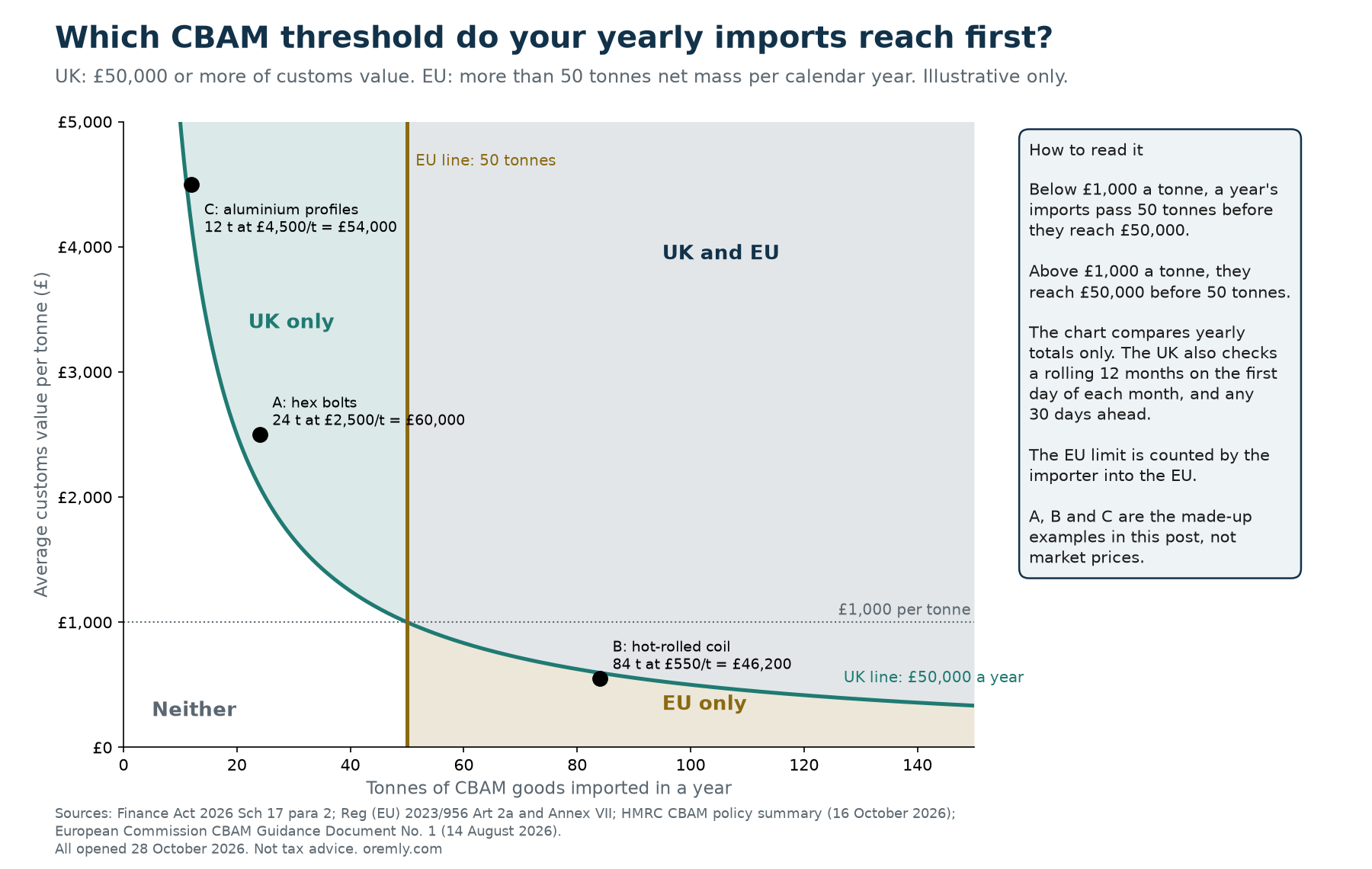
That is why the two tests catch different businesses. If you import higher-value goods, such as finished fasteners or aluminium profiles, and they average well over £1,000 a tonne, you can be caught in the UK while bringing in far less than 50 tonnes. If you import bulk, lower-value steel at under £1,000 a tonne, you can bring in more than 50 tonnes and still be under £50,000. Check your own value per tonne rather than relying on a sector average.
Two limits on the rule of thumb. It compares yearly totals, while the UK also tests a rolling 12 months each month and any 30 days ahead, so a single large shipment can catch you early. And the value side moves: a price rise or a weaker pound can take you over £50,000 with no change in tonnage.
Worked examples
Illustrative only. The businesses, tonnages, prices and dates below are made up and are not market prices. Default values are from the government's draft Default Values Force of Law Notice published on 16 October 2026, which has no force of law until 1 January 2027. The rates are HMRC's illustrative rates of 16 October 2026 (iron and steel £9.69, aluminium £9.79 per tCO2e), which HMRC says are not forecasts. They use the July to September 2026 average UK ETS price, initial free allocation data and the 2027 reduction factor of 97.5%. The real rates for January to March 2027 are due before the end of 2026. Costs are before any carbon price relief.
Example A: a fastener importer caught in the UK at 20 tonnes
A fastener importer brings in 2 tonnes of hex bolts (non-stainless, under 800 MPa, commodity code 73181582) on the first Wednesday of every month in 2027, at £2,500 a tonne. Each shipment is £5,000.
| Shipment (2027) | Running total, tonnes | Running total, value |
|---|---|---|
| Wednesday 6 January to Wednesday 1 September (9 shipments) | 18 | £45,000 |
| Wednesday 6 October | 20 | £50,000 |
| Wednesday 3 November | 22 | £55,000 |
| Wednesday 1 December | 24 | £60,000 |
- Forward test: at most two shipments, £10,000, fall in any 30 days, so not met.
- Backward test: on Friday 1 October the look-back (to 1 January 2027) finds £45,000, so not met. Imports reach exactly £50,000 on 6 October, which meets the threshold, because the test is "£50,000 or more". On HMRC's guidance, liability may date from 6 October. Under the law, the next first-of-month check is Monday 1 November 2027. Plan from 6 October.
- Charged: the nine shipments up to 1 September (18 tonnes, £45,000) were imported while the business was not registrable, so they are not charged. On the planning basis, 6 October, 3 November and 1 December are charged: 6 tonnes × 4.796 tCO2e per tonne (draft default value) = 28.776 tCO2e, × £9.69 = about £279. If only November and December are charged (the law's 1 November date): 4 tonnes × 4.796 = 19.184 tCO2e, × £9.69 = about £186. The real figure would use the iron and steel rate for October to December 2027.
- Register by 31 January 2028.
The EU comparison. If the same 24 tonnes were imported into the EU in a calendar year, they would never exceed 50 tonnes. That importer would be exempt for the year.
Example B: a steel stockholder under £50,000 at 84 tonnes
A stockholder brings in 7 tonnes of hot-rolled coil (under 3 mm, not pickled, 72083900) on the first Wednesday of every month in 2027, at £550 a tonne. Each shipment is £3,850.
- UK: 12 shipments × £3,850 = £46,200 for 2027. The forward test is never met, and on Saturday 1 January 2028 the look-back over 2027 finds £46,200. Not registrable, so nothing is charged, but keep the records.
- The price trap: at £600 a tonne, each shipment would be £4,200. After 11 shipments (Wednesday 3 November) the total is £46,200; the 12th, on Wednesday 1 December 2027, takes it to £50,400. A £50 a tonne price rise, about 9%, would make the business liable from 1 December on HMRC's guidance, or from Saturday 1 January 2028 under the law, with no extra tonnes. That is the case for checking your running total each month. Our CBAM threshold checker takes monthly values or a CSV of your import lines.
- The EU comparison: if the same imports went into the EU, the running total would be 49 tonnes after Wednesday 7 July, which does not exceed 50 tonnes. The 8th shipment, on Wednesday 4 August 2027, takes it to 56 tonnes. From then, EU obligations cover all 84 tonnes imported in 2027, including the 49 tonnes imported before August.
Example C: one aluminium shipment and the 30-day test
An aluminium fabricator expects a single shipment of 12 tonnes of hollow profiles of aluminium alloy (76042100) to arrive on Monday 15 March 2027, at £4,500 a tonne: £54,000. It imports nothing else in early 2027.
- Forward test: you trigger registration on the first day you expect to import £50,000 or more within the next 30 days. 15 March minus 30 days is Saturday 13 February 2027: HMRC tests the value "over the next 30 days", and 14 February to 15 March is 30 days. Counting the 30 days to include the day you test, the first date is Sunday 14 February. Plan from the earlier date, 13 February. If you only learn of the shipment later, within the 30 days, the test is met on the day you first expect it.
- Charged: the business is registrable when the profiles arrive, so they are charged: 12 tonnes × 3.894 tCO2e per tonne (draft default value) = 46.728 tCO2e, × £9.79 = about £457. The real figure would use the aluminium rate for January to March 2027.
- The EU comparison: 12 tonnes for the year does not exceed 50 tonnes, so an EU importer bringing in the same shipment would be exempt.
For how the charge itself is built up, see how UK CBAM is calculated and what the UK CBAM rate is.
A quick test for your own figures
1. List your CBAM goods. Check each commodity code against Schedule 16. Leave out goods that are not listed and those HMRC says do not count towards the threshold.
2. Work out the average customs value per tonne from last year's import entries. Above £1,000 a tonne, the UK threshold is the one you will reach first. HMRC's record-keeping guidance already asks you to keep the value and weight of each CBAM good from 1 January 2027, so the same records give you both figures.
3. Run the UK backward test month by month. Add up the customs value of the last 12 months' CBAM goods (for 2027, from 1 January 2027 only). Note the day the total reaches £50,000, and the first day of the next month.
4. Check the forward test before any large order. If one order, or several arriving within 30 days, adds up to £50,000 or more, you are liable from the day you expect it.
5. Allow for prices. Re-run step 3 at 10% higher prices. If that takes you over £50,000, treat yourself as likely to be liable.
6. If you also import into the EU, count tonnes for each EU importing entity separately, per calendar year. If you sell into the EU, ask your customers whether they expect to exceed 50 tonnes.
Our does UK CBAM apply to my business? post covers steps 1 and 3 in more detail.
Common mistakes
- "We import less than 50 tonnes, so we're exempt." That is the EU rule. The UK test is £50,000 of value.
- Counting the UK threshold by calendar year. The look-back is the previous 12 months, applied on the first day of each month, and there is a 30-day forward test as well.
- Waiting until imports "exceed" £50,000. The UK test is met at exactly £50,000.
- Looking for a small-consignment exemption. UK CBAM has no £500 or other per-consignment de minimis. The £500 figure some sites quote is HMRC's fixed penalty for not keeping CBAM records, not an exemption.
- Assuming both regimes treat earlier imports the same way. The EU brings in the whole year once you cross 50 tonnes. The UK does not charge goods imported before you became liable.
- Ignoring EU-origin goods. No country's goods are exempt from UK CBAM today.
Reader questions
Does the EU's 50 tonne threshold apply to UK imports?
No. It applies to goods imported into the EU. Goods imported into the UK are tested against the £50,000 value threshold.
Is there a weight threshold in UK CBAM?
No. The UK test is value only. HMRC's policy summary says that when you register you will be asked for the estimated weight of CBAM goods you expect to import in each sector over the next 12 months, but weight does not decide whether you must register.
Our EU customer says it is under 50 tonnes. Does that change anything for us?
Not for UK CBAM. It means your customer has no EU CBAM obligations for that year, so it is less likely to ask you for emissions data. If its imports pass 50 tonnes later in the year, that changes for the whole year.
Could the EU threshold change?
Yes, in principle. The Commission reviews it each year against its 1% of emissions target. Its 30 September 2026 assessment found 0.87%, below the limit. A change would need a delegated act, and only where the recalculated threshold differs from 50 tonnes by more than 15 tonnes.
Do imports from 2026 count towards the UK threshold?
No. HMRC says not to include the value of CBAM goods imported before 1 January 2027.
Where Oremly fits
Oremly maps each product to its commodity code and keeps a running £50,000 total from your import entries, so you can see the day you reach the threshold and the first-of-month check that follows. You still register, file and pay HMRC directly.
Sources
Primary sources checked on 28 October 2026:
- Finance Act 2026, Schedule 17, paragraph 2 (duty to register)
- Finance Act 2026, section 147 (exemptions) and section 156 (linked emissions trading schemes)
- Finance Act 2026, Schedule 16 (CBAM goods)
- CBAM: policy summary (HMRC, updated 16 October 2026)
- Work out the date you'll need to register for CBAM (HMRC, 16 July 2026)
- Check if you'll need to register for CBAM (HMRC collection)
- Keeping records for CBAM (HMRC, updated 16 October 2026; £500 fixed penalty)
- Imported CBAM goods that may not contribute towards the registration threshold (HMRC, 16 July 2026)
- The CBAM (Default Values) Force of Law Notice (Draft) (16 October 2026)
- Illustrative CBAM rates and worked example (HMRC, 16 October 2026) and Rates for CBAM (HMRC, 16 October 2026)
- Regulation (EU) 2023/956 (consolidated text of 20 October 2025), Article 2a and Annex VII (de minimis exemption), as inserted by Regulation (EU) 2025/2083
- Guidance Document No. 1: Introduction to CBAM concepts (European Commission, 14 August 2026)
- CBAM definitive regime and CBAM communication and news (European Commission; de minimis threshold assessment, 30 September 2026)
- Officially published: Simplifications for CBAM (European Commission, 20 October 2025)
Free founding access until 1 January 2027. No card required. From 1 January 2027, Oremly is £149/month, and founding members keep that price until 1 January 2029. We'll notify you before billing starts.
Ready to simplify your CBAM compliance?
Free until 1 January 2027 · £149/month locked until 2029 · No card required
Start free founding access