What is the UK CBAM rate? HMRC's illustrative £9.69 explained, with costs per tonne
Last verified: 26 October 2026
Author: Oremly
Short answer: the UK CBAM rate is a sterling amount per tonne of carbon dioxide equivalent (tCO2e) embodied in your imported goods. There is one rate per sector, and it changes every quarter. No rate is in force yet. On 16 October 2026 HMRC published illustrative rates: £9.69 per tCO2e for iron and steel and £9.79 for aluminium. HMRC says these "should not be interpreted as forecasts or as the rates that will apply when CBAM liability begins". The first real rates, for imports from 1 January to 31 March 2027, will be published before the end of 2026.
This post explains where those figures come from, why the UK rate looks so much lower than the EU CBAM certificate price you may have seen, which quarter's rate applies to an import, and what the illustrative rate means per tonne of bolts, coil, sections and aluminium profiles. It is not tax advice. Oremly is software and plain-English guidance.
HMRC's illustrative UK CBAM rates (published 16 October 2026)
| Sector | HMRC illustrative rate per tCO2e |
|---|---|
| Iron and steel | £9.69 |
| Aluminium | £9.79 |
| Cement | £8.78 |
| Hydrogen | £9.24 |
| Fertiliser | £1.45 |
These are the rates that would apply from 1 January 2027 if they were worked out on data available now. HMRC used the average UK Emissions Trading Scheme (UK ETS) auction price for July to September 2026 (£58.15) and preliminary free allocation data that the UK ETS Authority is still checking. HMRC's note says the figures "do not create or imply any tax liability for any business". Treat them as a sense of scale for budgeting, not as a price.
How the rate is worked out
Finance Act 2026, section 149, sets the method in two steps, and the illustrative note shows the same steps with numbers:
1. Average UK ETS price. Take the mean of all UK ETS auction clearing prices in the quarter before the quarter the rate is for.
2. Free allocation adjustment. Reduce that price by the sector's *baseline free allocation percentage* (the share of UK producers' direct emissions in that sector covered by free allowances in 2019, 2022 and 2023), adjusted by a *reduction factor* for the year that reflects free allowances being phased out. HMRC gives the 2027 reduction factor as 97.5% for all five sectors.
The detail of both steps is in S.I. 2026/809, which the House of Commons approved on 14 October 2026 and which comes into force on 1 January 2027.
In one line:
CBAM rate = average UK ETS price × [1 − (baseline free allocation % × reduction factor)]
HMRC's own worked example is for cement: £58.15 × [1 − (87.1% × 97.5%)] = £8.78 per tCO2e. Checking it step by step: 87.1% × 97.5% = 84.92%; 1 − 0.8492 = 0.1508; £58.15 × 0.1508 = £8.77. HMRC shows £8.78 and notes that "due to presentational rounding, totals may not exactly correspond to the calculation of individual items".
HMRC's note does not publish the iron and steel or aluminium percentages. Working backwards from the rounded figures (our calculation, not an HMRC number), £9.69 implies that free allowances covered roughly 85% of the direct emissions of UK iron and steel sites in the baseline years (2019, 2022 and 2023), on HMRC's preliminary data. That is why the iron and steel rate is only about a sixth of the UK ETS price (£9.69 ÷ £58.15 = 16.7%): UK producers in the sector pay for only part of their emissions, and CBAM is designed to put a matching price on imports.
Why £9.69 is not the EU's €82
If you also trade with the EU, you may have seen the EU CBAM certificate price for July to September 2026: €82.32, published by the European Commission on 5 October 2026. That is a different number for a different tax:
- It reflects EU ETS prices. The Commission says the certificate price reflects the average price of EU ETS allowances. The UK rate is built from UK ETS auction prices.
- The UK rate already includes the free allocation adjustment. The £9.69 is the figure you multiply your embodied emissions by. The EU certificate price sits inside a separate scheme with its own rules, so the two numbers are not like for like.
- They are separate taxes. Paying one does not settle the other. If you import into the UK, the UK rate is the one that matters for UK CBAM.
So do not budget for UK CBAM using EU certificate prices. A tonne of emissions does not cost €82 under the UK scheme on HMRC's illustrative figures.
What moves the rate from quarter to quarter
HMRC says rates "will be updated and published quarterly to reflect changes in the average UK ETS price and the applicable free allowance phase-out reduction factor". In practice:
- The UK ETS price. The rate moves in proportion to it. If the average auction price for the previous quarter were 10% higher, with the same free allocation inputs, the rate would be 10% higher.
- The reduction factor. HMRC describes it as reflecting "the gradual withdrawal of free UK ETS allowances". As free allowances are phased out, the factor falls in later years and the rate rises for the same UK ETS price. HMRC's note uses the 2027 factor of 97.5%. The law sets 95% for 2028, 90% for 2029 and 77.5% for 2030, unless the government changes them by order before the start of the year (S.I. 2026/809, regulation 4, applying the factors set by S.I. 2026/278).
- The baseline free allocation percentage. HMRC says the list of UK sub-installations used to work it out "will be finalised for 1 January 2027", and that any revisions will be reflected in the CBAM rate for Q1 2027. So the Q1 2027 rate could differ from the illustrative one even if the UK ETS price stayed the same.
We do not forecast rates. The useful planning point is direction: on the method in law, the rate is designed to rise as UK free allowances are withdrawn.
Which quarter's rate applies to your import
There is one rate per sector per quarter. HMRC's rates guidance says the rate depends on the sector your goods belong to and the quarter they were imported into the UK. Its example: steel bars imported in February 2028 use the iron and steel rate for 1 January to 31 March 2028. (The law refers to the quarter in which the liability to CBAM is incurred; HMRC's guidance treats that as the quarter of import.)
From 1 January 2027, HMRC will publish each quarter's rates by the beginning of that quarter:
- 1 January to 31 March (first quarter)
- 1 April to 30 June (second quarter)
- 1 July to 30 September (third quarter)
- 1 October to 31 December (fourth quarter)
Illustrative example: bolts imported on Friday 14 May 2027
1. 14 May 2027 falls between 1 April and 30 June 2027, so it is in the second quarter of 2027.
2. The rate that applies is the iron and steel rate for 1 April to 30 June 2027.
3. That rate is built from UK ETS auction prices in the previous quarter, 1 January to 31 March 2027.
4. HMRC publishes it by 1 April 2027 at the latest, 43 days (about six weeks) before the goods land.
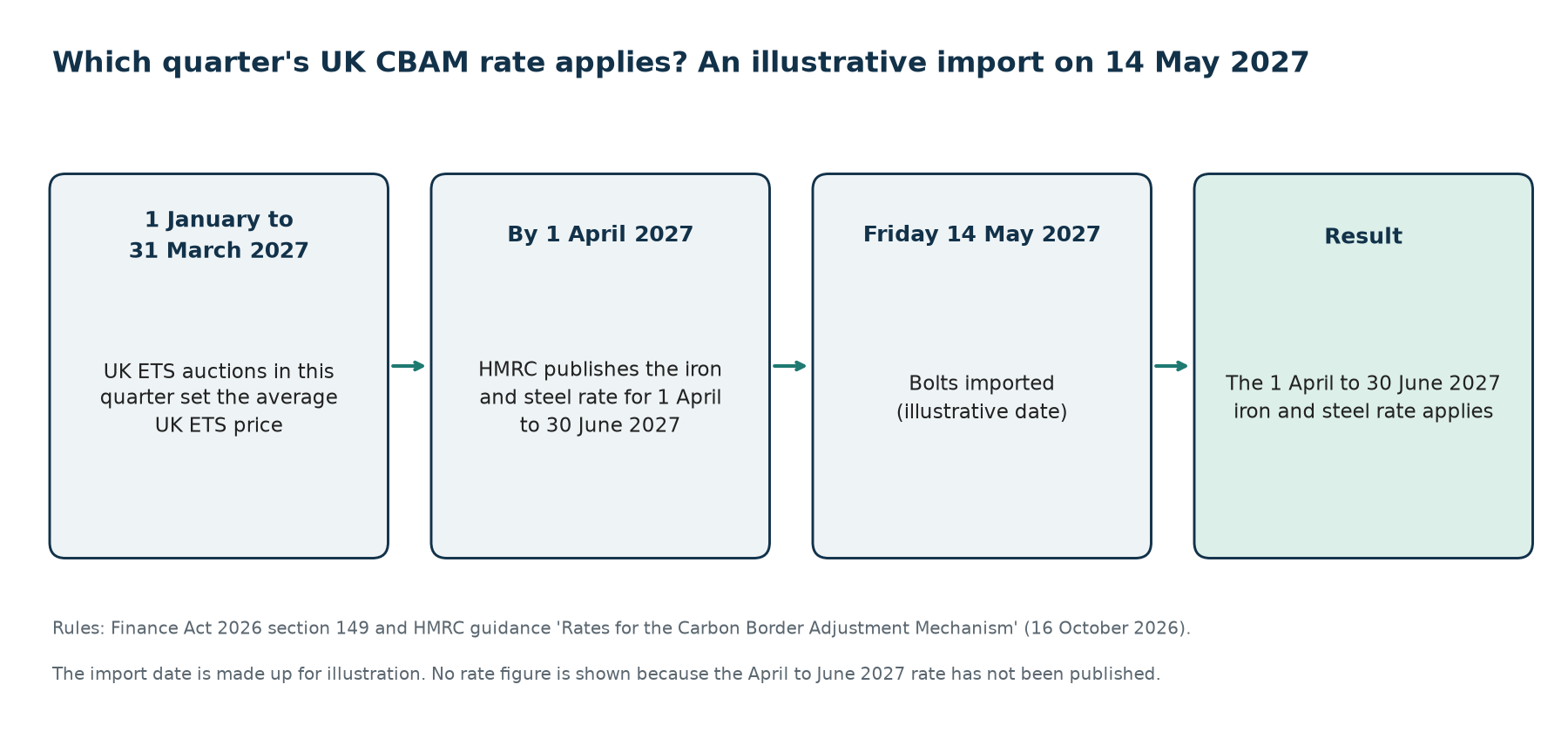
For finance teams the consequence is simple: when you quote a customer in March for goods arriving in May, the rate for May is not yet known. You will be estimating, and the illustrative rate is a reasonable guide to the scale, not the figure.
What the illustrative rate means per tonne of your goods
The rate is per tonne of emissions, not per tonne of product. To turn it into a cost per tonne of product, multiply by the emissions intensity of the goods. On 16 October 2026 the government also published draft default values (emissions intensities the UK will use where you have no verified supplier data), listed by 8-digit CN code. They include a 10% markup in every sector except fertiliser, and are due to apply from 1 January 2027 to 31 December 2028 once the notice comes into force.
Two separate checks, in this order: first confirm your goods are in scope under Schedule 16 of the Finance Act 2026, which lists goods mainly by chapter, 4-digit heading and 6-digit sub-heading, with a few 8-digit codes (see Schedule 16 on legislation.gov.uk). Then look up the draft default value for your 8-digit CN code.
Illustrative only. Default values are from the draft notice published on 16 October 2026. Rates are HMRC illustrative rates, not the rates that will apply. Costs are before any carbon price relief.
| Goods (CN code) | Draft default value, tCO2e per tonne | HMRC illustrative rate | Illustrative cost per tonne |
|---|---|---|---|
| Hex bolts, non-stainless, under 800 MPa (73181582) | 4.796 | £9.69 | 4.796 × £9.69 = £46.47 |
| Hex bolts, non-stainless, 800 MPa or more (73181588) | 6.077 | £9.69 | 6.077 × £9.69 = £58.89 |
| Nuts, non-stainless, inside diameter over 12 mm (73181699) | 4.890 | £9.69 | 4.890 × £9.69 = £47.38 |
| Hot-rolled coil, under 3 mm, not pickled (72083900) | 3.468 | £9.69 | 3.468 × £9.69 = £33.60 |
| Ribbed steel bars and rods (72142000) | 3.040 | £9.69 | 3.040 × £9.69 = £29.46 |
| I sections, height 80 to 220 mm (72163211) | 2.633 | £9.69 | 2.633 × £9.69 = £25.51 |
| Aluminium alloy hollow profiles (76042100) | 3.894 | £9.79 | 3.894 × £9.79 = £38.12 |
| Aluminium alloy bars and rods (76042910) | 3.365 | £9.79 | 3.365 × £9.79 = £32.94 |
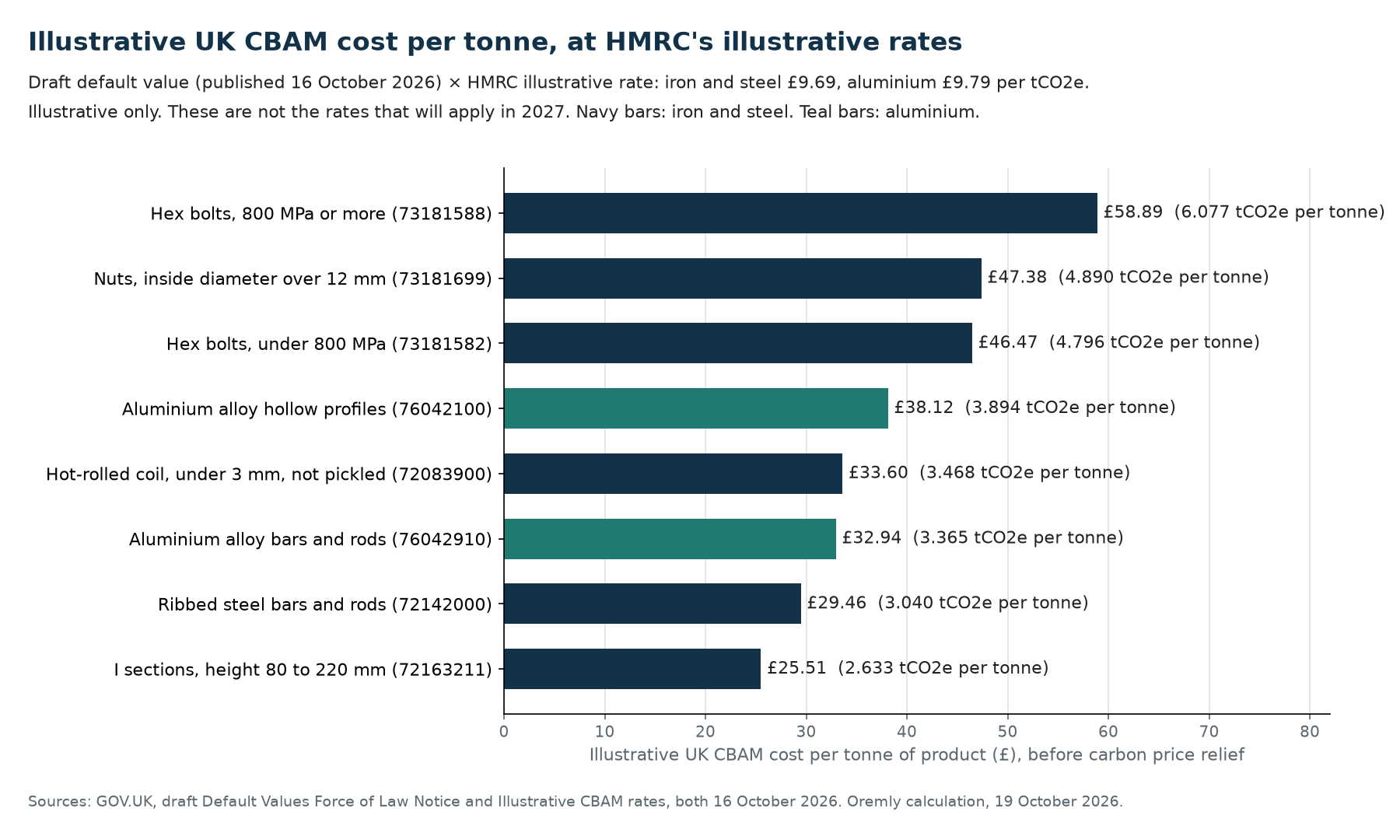
A handy rule of thumb from the same numbers: every £1 on the rate adds the default value in pounds per tonne. For hex bolts under 800 MPa, each £1 per tCO2e adds £4.80 per tonne of bolts. If the rate doubled, so would the cost.
Worked example: a fastener importer's quarter
Illustrative only. The business, tonnage, customs value and supplier figure below are made up. The default value is from the draft notice of 16 October 2026 and the rate is HMRC's illustrative iron and steel rate, not the rate that will apply.
A UK fastener distributor imports 40 tonnes of non-stainless hex bolts under 800 MPa (CN 73181582) in a quarter, with a customs value of £60,000. It has no verified supplier data, so it uses the draft default value.
1. Embodied emissions: 40 tonnes × 4.796 tCO2e per tonne = 191.84 tCO2e.
2. CBAM charge at the illustrative rate: 191.84 × £9.69 = £1,858.93.
3. As a share of customs value: £1,858.93 ÷ £60,000 = about 3.1%.
4. Carbon price relief: none here. If the bolts had paid a carbon price under a qualifying scheme abroad, relief could reduce the charge (see HMRC's guidance on working out carbon price relief).
What verified supplier data could be worth. Suppose the supplier could provide a verified figure of 3.500 tCO2e per tonne (made up for this example):
- Gap per tonne: 4.796 − 3.500 = 1.296 tCO2e.
- Saving per tonne at the illustrative rate: 1.296 × £9.69 = £12.56.
- Saving on 40 tonnes: 1.296 × 40 = 51.84 tCO2e; 51.84 × £9.69 = £502.33 for the quarter.
Whether that is worth chasing depends on what the data costs you, and the saving grows as the rate rises. Our post on UK CBAM default values or supplier data sets out the decision test. For the full calculation from weight to liability, see how is UK CBAM calculated?
A short checklist for finance teams
1. Scope first. Confirm which of your goods are in Schedule 16. Check the named exceptions too: ferrous scrap (heading 7204), several ferro-alloys and some fertilisers are excepted, while aluminium scrap (7602) is simply not listed.
2. Threshold. Check whether your in-scope imports will reach £50,000. The law applies the 12-month test when "it is the first day of the month" (Schedule 17, paragraph 2(2)(a)), but HMRC's guidance says that if it is met, "you may be liable to register for CBAM from the date your imports met the £50,000 registration threshold", so plan from that date. If you expect to import £50,000 or more within the next 30 days, you are liable to register from that day. If both apply, HMRC says to "use the earliest date on which you become liable for CBAM as your registration start date". Use the CBAM threshold checker for a rough check.
3. Build a per-tonne estimate. For each 8-digit CN code you import: draft default value × illustrative rate. Label it as an estimate in your budget.
4. Diarise the rate dates. The first real rates (January to March 2027) are due before the end of 2026. After that, look for each quarter's rate by the start of the quarter.
5. Record the import date for every consignment. It decides which quarter's rate applies.
6. Ask suppliers for verified data on your highest-tonnage lines. The draft defaults include a 10% markup, so a verified figure may well be lower.
7. Do not write illustrative rates into contracts as fixed figures. If you pass CBAM costs on, tie the clause to the rate HMRC publishes for the quarter of import.
Common mistakes
- Treating £9.69 as the 2027 rate. It is an illustration on July to September 2026 data. The real January to March 2027 rate comes later in 2026.
- Using EU certificate prices for UK budgets. The €82.32 EU figure is a different tax with a different basis.
- Multiplying the rate by tonnes of product. The rate is per tonne of emissions. Multiply by the emissions intensity first.
- Using the wrong quarter. It is the quarter of import, not the quarter of order, invoice or production.
- Deciding scope at 8 digits. Scope is set by the codes listed in Schedule 16, which are mostly chapters, 4-digit headings and 6-digit sub-headings. The 8-digit CN codes in the draft notice are for looking up default values.
Reader questions
Is there one rate for all steel products?
Yes. There is one iron and steel rate per quarter. What differs between bolts, coil and sections is the emissions intensity, not the rate.
Will the UK CBAM rate go up?
The method is designed to rise as UK free allowances are phased out, and it also moves with the UK ETS price. HMRC has not forecast future rates, and neither do we.
When will I know the real rate for January to March 2027?
HMRC says it will be published before the end of 2026.
Does the rate include carbon price relief?
No. Carbon price relief is worked out separately and taken off the CBAM charge.
Where Oremly fits
Oremly helps UK importers map products to CBAM commodity codes, track the £50,000 threshold, hold the default value or verified supplier figure for each line, and apply the published rate for the quarter of import once HMRC releases it. You still register and file with HMRC.
Sources
Primary sources checked on 26 October 2026:
- Illustrative CBAM rates and worked example (HMRC, 16 October 2026)
- Rates for the Carbon Border Adjustment Mechanism (CBAM) (HMRC guidance, 16 October 2026)
- The CBAM (Default Values) Force of Law Notice (Draft) (16 October 2026)
- CBAM: policy summary (updated 16 October 2026)
- Finance Act 2026, section 149 (rate method)
- S.I. 2026/809, the CBAM (Calculation of CBAM Rate and Determination of Carbon Price Relief) Regulations 2026 (average UK ETS price; reduction factor)
- The Greenhouse Gas Emissions Trading Scheme (Amendment) Order 2026 (S.I. 2026/278) (reduction factors 2027 to 2030)
- UK Parliament procedure record for S.I. 2026/809 (approved by the House of Commons, 14 October 2026)
- Work out your Carbon Price Relief (HMRC guidance, 16 July 2026)
- Work out the date you'll need to register for CBAM (16 July 2026)
- Finance Act 2026, Schedule 17 (paragraph 2(2)(a), the monthly look-back)
- European Commission: price of CBAM certificates (EU Q3 2026 price, published 5 October 2026)
Free founding access until 1 January 2027. No card required. From 1 January 2027, Oremly is £149/month, and founding members keep that price until 1 January 2029. We'll notify you before billing starts.
Ready to simplify your CBAM compliance?
Free until 1 January 2027 · £149/month locked until 2029 · No card required
Start free founding access