How is UK CBAM calculated? A worked example for importers
Last verified: 26 October 2026
Author: Oremly
UK CBAM is charged on the emissions embodied in the goods you import, not on their value. For each consignment you multiply the net weight by an emissions intensity, multiply the result by the CBAM rate for that sector and quarter, then take off any carbon price relief. This post walks through each input, works through one consignment of bolts using the draft default value and HMRC's illustrative rate published on 16 October 2026, shows every date that matters, and ends with the data you need to collect from 1 January 2027.
It is not tax advice. Oremly is software and plain-English guidance; you file your own returns with HMRC. If you have not yet checked whether UK CBAM applies to you at all, start with does UK CBAM apply to my business? and the CBAM threshold checker.
The calculation in three steps
1. Embodied emissions = net weight of the goods (tonnes) × emissions intensity (tonnes of CO2 equivalent, tCO2e, per tonne of goods).
2. CBAM charge = embodied emissions × the CBAM rate for the goods' sector in the quarter the liability arises.
3. CBAM liability = CBAM charge minus carbon price relief, if any. Relief can never be more than the liability, so the result cannot go below nil.
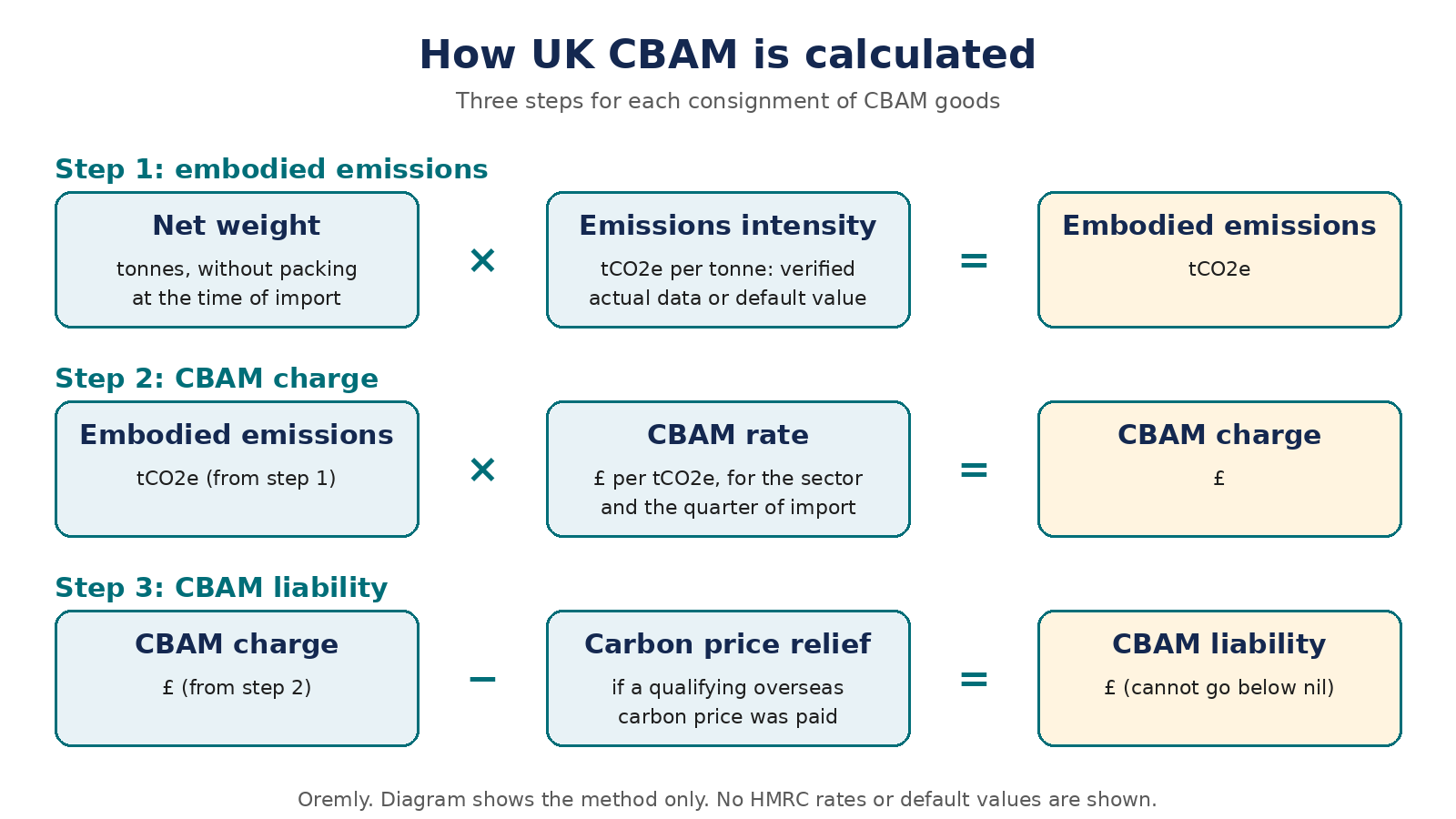
Finance Act 2026 sets the core rule: CBAM is charged at the "sectoral domestic price" for the good multiplied by the tonnes of CO2 equivalent embodied in it. The four inputs below are where the work is.
Input 1: net weight
The weight is the weight of the goods without packing materials or containers, at the time of import. You report it on the return in kilograms and HMRC converts it to tonnes.
HMRC's record-keeping guidance gives import declarations, commercial invoices, carrier weight records, bills of lading and packing lists as examples of weight evidence. Returns need the actual weight. The estimates HMRC asks for at registration are separate, and you must keep evidence of how you made them. If the required records are missing, HMRC may determine the weight itself, using estimates or comparisons with similar goods.
Note that customs value is used for the £50,000 registration threshold, not for the tax. The tax itself is driven by weight and emissions.
Input 2: emissions intensity (actual data or a default value)
The emissions intensity is how many tonnes of CO2 equivalent are embodied in each tonne of the good. (For cement and fertilisers it is measured per tonne of clinker or of nitrogen, then converted.) There are two ways to get it:
- Actual emissions data from the producer, verified by a qualifying verifier. You keep the verification report or summary for six years.
- A default emissions value set by the government. HMRC's guidance says you must use a default value if actual data is not available to you, or if you do not have evidence that the data has been verified.
For goods imported in 2027, HMRC's guidance on getting the emissions intensity says to ask your supplier for verified data for calendar year 2027, and if that is not available, for the previous calendar year (2026). There is also an option to use data for the calendar year the goods were produced.
Two points to know before you file:
- Default values are published in draft. On 16 October 2026 the government published a draft notice with 570 default values, one for each listed 8-digit CN code, in tCO2e per tonne. They include a 10% markup in every sector except fertiliser. They are due to apply from 1 January 2027 to 31 December 2028, and the notice has no force of law until it is commenced on 1 January 2027, so the figures could still change. From 2029 the UK plans one default value per good per country. Example: non-stainless hex bolts with a tensile strength under 800 MPa (CN 73181582) have a draft default value of 4.796 tCO2e per tonne.
- You cannot swap later. Once a return uses a default value, Finance Act 2026 does not allow you to amend it to replace that figure with actual emissions data. Decide which route you are taking before you file.
Complex goods that contain other CBAM goods (precursors) also carry the emissions of those precursors. The producer adds these in when calculating the verified figure, so ask your supplier to confirm that their figure includes them.
Input 3: the CBAM rate
There is one rate per sector (aluminium, cement, fertilisers, hydrogen, iron and steel), set each quarter. The rate that applies is the one for the quarter in which your liability arises, which is usually when the goods become liable to import duty (or would be, if no duty were due).
Each quarter's rate is worked out from the previous quarter:
1. Take the average of all UK Emissions Trading Scheme (UK ETS) auction clearing prices in the quarter before.
2. Reduce it to reflect the share of that sector's emissions covered by free allowances, adjusted by a reduction factor as free allowances are phased out.
The detailed rules for these two steps are in S.I. 2026/809, which the House of Commons approved on 14 October 2026 and which comes into force on 1 January 2027. From 1 January 2027, HMRC will publish each quarter's rates by the beginning of that quarter. The first real rates, for 1 January to 31 March 2027, will be published before the end of 2026.
On 16 October 2026 HMRC published illustrative rates worked out on current data: £9.69 per tCO2e for iron and steel and £9.79 for aluminium. They use the average UK ETS auction price for July to September 2026 (£58.15) and preliminary free allocation data. HMRC says they "should not be interpreted as forecasts or as the rates that will apply when CBAM liability begins". Use them for a sense of scale, not as a price.
Input 4: carbon price relief
If the goods were made somewhere that already charged a carbon price under a qualifying carbon pricing scheme, you can claim relief. You need a carbon pricing verification form from the producing installation, completed by an independent, accredited verifier, for each CBAM good you claim on.
In short:
1. Work out the effective carbon price from the verification form and the scheme's published prices (free allowances count as zero, and compensation or rebates are taken off).
2. Multiply it by the embodied emissions that were subject to the scheme.
3. Convert to sterling using the HMRC exchange rate for the calendar quarter before the import, and round down to two decimal places.
HMRC's list of qualifying schemes is based on information as of 19 June 2026, is not exhaustive and will be updated, so check it close to the time. Full detail is in HMRC's guidance on working out carbon price relief.
Illustrative example: one consignment of bolts
Illustrative only. The business, weight, import date, supplier figure, overseas carbon price and exchange rate below are made up to show the method. The default value is from the draft notice published on 16 October 2026. The rate is HMRC's illustrative iron and steel rate of 16 October 2026 (£9.69 per tCO2e), used here as a stand-in for the April to June 2027 rate, which is not yet known. Neither figure is guaranteed to be the one that applies.
A UK fastener importer brings in one consignment of non-stainless hex bolts with a tensile strength under 800 MPa (CN 73181582, heading 7318, iron and steel sector). The goods become liable to import duty on Friday 14 May 2027. We work it out two ways: first with the draft default value, then with a verified supplier figure and carbon price relief.
Version A: no verified supplier data, so the default value is used
| Item | Figure | Working |
|---|---|---|
| Net weight | 24,000 kg | 24,000 ÷ 1,000 = 24 tonnes |
| Emissions intensity | 4.796 tCO2e per tonne | Draft default value for CN 73181582 (16 October 2026) |
| Embodied emissions | 115.104 tCO2e | 24 × 4.796 |
| CBAM rate | £9.69 per tCO2e | HMRC illustrative iron and steel rate (16 October 2026) |
| CBAM charge | £1,115.36 | 115.104 × £9.69 = £1,115.35776, shown to the nearest penny |
| Carbon price relief | £0.00 | None claimed |
| CBAM liability | £1,115.36 | £1,115.36 − £0.00 |
HMRC has not yet said how the return rounds embodied emissions. If it rounded to whole tonnes, Version A would be 115 × £9.69 = £1,114.35.
Version B: verified supplier data and carbon price relief
The producer sends a verified figure of 2.00 tCO2e per tonne (made up), and the installation pays a carbon price under a qualifying scheme that prices in euros.
| Item | Figure | Working |
|---|---|---|
| Net weight | 24 tonnes | As above |
| Emissions intensity | 2.00 tCO2e per tonne | Producer's verified figure (made up) |
| Embodied emissions | 48 tCO2e | 24 × 2.00 |
| CBAM rate | £9.69 per tCO2e | HMRC illustrative iron and steel rate (16 October 2026) |
| CBAM charge | £465.12 | 48 × £9.69 |
| Effective carbon price | €5.00 per tCO2e | From the verification form and scheme prices (made up) |
| Relief in euros | €240.00 | 48 × €5.00 |
| Exchange rate, January to March 2027 | £0.85 per €1 | Made up: HMRC publishes these rates from 1 January 2027 |
| Carbon price relief | £204.00 | €240.00 × 0.85, rounded down to two decimal places (no change) |
| Relief cap check | £204.00 is less than £465.12 | Relief allowed in full |
| CBAM liability | £261.12 | £465.12 − £204.00 |
On these figures, verified data and relief together cut the bill for this consignment from £1,115.36 to £261.12. The verified figure alone accounts for £650.24 of that (£1,115.36 − £465.12), and relief for the other £204.00.
The dates that decide which figures apply:
- Quarter of liability: 14 May 2027 falls in the quarter 1 April to 30 June 2027, so the iron and steel rate for that quarter applies.
- What that rate is based on: UK ETS auction prices in the previous quarter, 1 January to 31 March 2027. HMRC publishes the rate by the beginning of the quarter, so by 1 April 2027, 43 days before the import.
- Exchange rate for relief: the HMRC rate for the calendar quarter before the import, January to March 2027.
- Overseas carbon price: the scheme's published price from the previous calendar quarter (January to March 2027), averaged if it changed.
- Verification form data: emissions for 2025 or 2026 (one of the two calendar years before the 2027 import).
- Emissions intensity: verified data for calendar year 2027 if it exists, otherwise 2026. If neither is available with evidence of verification, the default value applies (Version A).
- Default value: the draft notice values apply to imports from 1 January 2027 to 31 December 2028, so 14 May 2027 is covered, once the notice is in force.
- Return and payment: 2027 is a single annual accounting period (1 January to 31 December 2027), so this consignment goes on the return due by 31 May 2028. The return records the quarter in which each good passed the tax point.
Why relief is capped at the charge. Relief recognises a carbon price already paid abroad, but HMRC's guidance says the total relief claimed cannot exceed the CBAM liability due. It can bring the liability down to nil, never below it. At a low UK rate this matters: a modest overseas carbon price can wipe out the UK charge. Suppose the effective carbon price in Version B were €20.00 instead of €5.00. Relief would work out at 48 × €20.00 = €960.00, × 0.85 = £816.00, which is more than the £465.12 charge. You could claim only £465.12, the liability would be £0.00, and the other £350.88 (£816.00 − £465.12) could not be claimed. You would still need to file the return: HMRC expects a return for every accounting period once you are registrable, even with nothing to pay.
Data to collect for every consignment from 1 January 2027
Use this as a checklist with your customs broker and suppliers. Records must be kept for six years.
- [ ] 8-digit commodity code and goods description from the import declaration
- [ ] Date the goods became liable to import duty (this sets the quarter and the rate)
- [ ] Net weight in kilograms, without packing, and the document it came from
- [ ] Customs value (for the £50,000 registration threshold)
- [ ] Country of origin under the non-preferential rules
- [ ] Emissions intensity, and the verification report or summary behind it, or a note that you are using the default value
- [ ] If claiming relief: the carbon pricing verification form, the scheme's published prices for the previous quarter, and the exchange rate used
HMRC's policy summary says each consignment of the same good, and each different good in the same shipment, must be reported separately on the return, so keep each line separate in your own records too.
Common mistakes to avoid
- Using gross weight. The weight excludes packing and containers.
- Using customs value to estimate the tax. Value decides whether you must register. Weight and emissions decide how much you pay.
- Using the wrong quarter. The rate is set by the quarter your liability arises in, and the exchange rate for relief comes from the quarter before the import.
- Assuming EU CBAM figures apply. UK CBAM is a separate UK tax with its own rates and returns. Use HMRC's rates guidance, not EU figures.
- Filing on default values while waiting for supplier data. You cannot replace a default value with actual data by amending the return afterwards.
- Treating £9.69 as the 2027 rate. It is HMRC's illustration on July to September 2026 data. The real rate for each quarter is published by the start of that quarter.
Where Oremly fits
Oremly helps UK importers read the import ledger, chase supplier emissions data, calculate liability, store evidence and prepare a return-ready summary. It does not file the return; you file through HMRC. To see whether you are likely to cross the threshold first, try the CBAM threshold checker, and for HMRC's full guidance see the CBAM collection on GOV.UK.
Sources
Primary sources checked on 26 October 2026:
- Finance Act 2026, Part 5 (section 149 rate; section 150 carbon price relief)
- Finance Act 2026, Schedule 17 (returns and amendments; default values)
- S.I. 2026/809 (calculation of the CBAM rate and carbon price relief)
- UK Parliament procedure record for S.I. 2026/809 (approved by the House of Commons, 14 October 2026)
- S.I. 2026/995 (emissions, default values and weight)
- S.I. 2026/830 (first accounting period and return date)
- The CBAM (Default Values) Force of Law Notice (Draft) (16 October 2026)
- Illustrative CBAM rates and worked example (HMRC, 16 October 2026)
- Rates for CBAM (16 October 2026)
- Getting the emissions intensity when importing CBAM goods (16 October 2026)
- CBAM policy summary (updated 16 October 2026)
- Work out your Carbon Price Relief (16 July 2026)
- Keeping records for CBAM (updated 16 October 2026)
- Prepare for CBAM collection (updated 9 September 2026)
Free founding access until 1 January 2027. No card required. From 1 January 2027, Oremly is £149/month, and founding members keep that price until 1 January 2029. We'll notify you before billing starts.
Ready to simplify your CBAM compliance?
Free until 1 January 2027 · £149/month locked until 2029 · No card required
Start free founding access