When do I need to register for UK CBAM? Dates for 2027 imports
Last verified: 26 October 2026
Author: Oremly
Crossing the £50,000 threshold is only half the story. The other half is the calendar: the day you become liable to register, the day you must actually register by, and the day your first return is due. Those three dates are not the same, and for anyone who first triggers in 2027 the registration deadline is a fixed date, not the usual 30 days.
This post gives you that calendar, a checklist for the months before the registration service opens, and an illustrative example with every date worked out. It is not tax advice. Oremly is software and plain-English guidance; you register and file with HMRC. If you have not yet checked whether UK CBAM applies to you at all, start with does UK CBAM apply to my business? and the CBAM threshold checker.
First: when do you become liable to register?
You must register if you are the importer of CBAM goods in the course of a business and you meet either of the two threshold tests in Finance Act 2026, Schedule 17:
1. Forward test. On any day on or after 1 January 2027, you expect to import in-scope CBAM goods with an aggregate customs value of £50,000 or more within the next 30 days. You are liable to register from that day.
2. Backward test. Schedule 17 (paragraph 2(2)(a)) applies this test when "it is the first day of the month": did CBAM goods imported in the preceding 12 months total £50,000 or more? For imports in 2027, look back only to 1 January 2027. Pre-2027 imports do not count. HMRC's guidance on working out your registration date says that if this check is met, "you may be liable to register for CBAM from the date your imports met the £50,000 registration threshold". That date can fall before the first of the month, so plan from it.
If both tests are met, HMRC says to "use the earliest date on which you become liable for CBAM as your registration start date". Value means the customs value used (or that would be used) for import duty. Match commodity codes to Schedule 16, and run a rough check with the CBAM threshold checker if you need one.
You only reach this post's calendar if those tests put you in. The rest of this article assumes they do.
The three dates that matter
Keep these separate in your diary:
| Date | What it is | Where it comes from |
|---|---|---|
| Liability date | The day you first become liable to register (forward or backward test) | Finance Act 2026, Schedule 17, paragraph 2; HMRC registration-date guidance |
| Registration deadline | The last day by which you must register | Ordinary rule: 30 days from the liability date. If you first triggered in 2027: 31 January 2028 (SI 2026/830) |
| First return deadline | Return and payment for the 2027 accounting period | 31 May 2028 (SI 2026/830) |
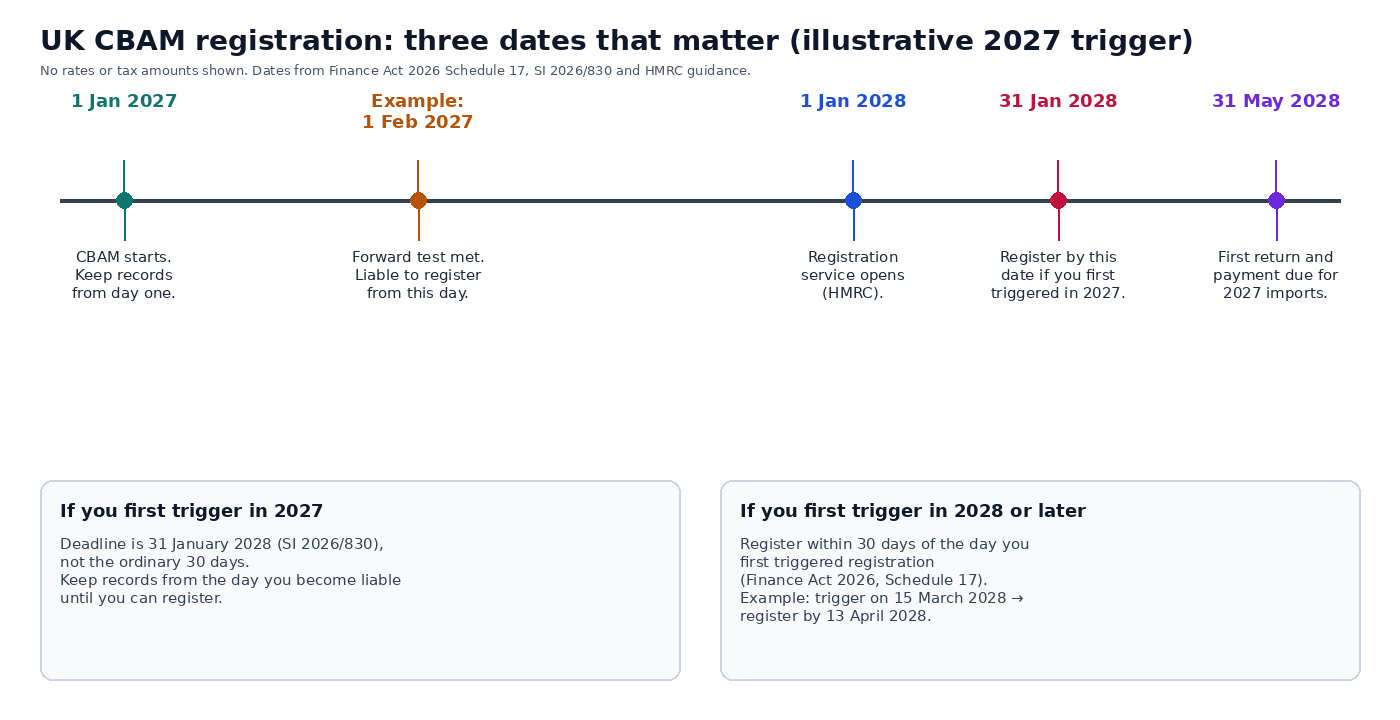
GOV.UK says registration for CBAM will open on 1 January 2028. HMRC updated its records guidance to say this on 16 October 2026, and the registration check collection says the same. Plan to register from the start of 2028, and do not wait until the end of January to gather what you need.
What to do in 2027 before the service opens
If you become liable in 2027, you cannot register on the day liability starts, because the service is not open yet. That gap is intentional. SI 2026/830 gives anyone who first triggers registration in 2027 until 31 January 2028 to register. Between the liability date and registration you must keep the records that will let you register and, later, file.
From HMRC's records guidance and the policy summary, build a pack that includes:
- Identity and business details you will need on the form: name, contact details, business address, business type, EORI, and VAT number if you have one.
- The liability date you will declare as the date you triggered registration, with a short note of which test you used (forward or backward) and the consignments that got you there. For the backward test, record both the monthly check date and the date your imports met the £50,000 threshold.
- For each CBAM consignment from 1 January 2027: commodity code and description, tax-point date, customs value, and net weight, with evidence (import declaration, invoice, carrier weight record, bill of lading or packing list).
- Weight estimates by sector for the next 12 months (aluminium, cement, fertiliser, iron and steel, hydrogen). HMRC asks for these at registration. Keep a note of how you estimated them.
- Evidence for any consignments you treated as outside the threshold (for example UK origin or returned goods), so you can show why their value was left out.
HMRC can charge a failure-to-notify penalty if you register late or not at all: up to 30% of the CBAM due for the late period if the failure was not deliberate, and up to 70% or 100% if it was deliberate, reduced if you tell HMRC yourself (Finance Act 2008, Schedule 41, applied by Finance Act 2026, Schedule 17, paragraph 34), and a separate £500 penalty if you do not keep the required records. Treat the 2027 pack as both a registration file and a return file.
Illustrative example: one stockholder, three dates
Illustrative only. The business, consignments and values below are made up to show the method. No CBAM rates or default emissions values are used.
A UK steel stockholder expects, on Monday 1 February 2027, to import hot-rolled coil with a customs value of £60,000 on Sunday 14 February 2027. The goods are Schedule 16 iron and steel lines, the firm is the importer, and no exclusion applies.
Step 1: liability date (forward test)
- On 1 February 2027 the firm expects £60,000 of CBAM goods within the next 30 days (14 February is 13 days later).
- The forward test is met on 1 February 2027. That is the liability date.
Step 2: registration deadline
- The firm first triggered registration in 2027, so SI 2026/830 replaces the ordinary 30-day rule.
- It must register before the end of 31 January 2028 (a Monday).
- Under the ordinary rule it would have had until 2 March 2027 (30 days beginning with 1 February 2027). The transitory rule is longer, not shorter, but it still has a hard stop in January 2028.
Step 3: what happens in between
- From 1 February 2027 the firm keeps the consignment pack above for every CBAM import through the year.
- On 1 January 2028 (a Saturday) the registration service is due to open. The firm registers in the first working days of January, well before 31 January, using its Government Gateway account.
Step 4: first return
- All 2027 imports sit in the first accounting period: 1 January to 31 December 2027.
- Return and payment are due by 31 May 2028 (a Wednesday). That is a separate deadline from registration. Registering in January does not file the return for you.
Contrast: first trigger in 2028
If the same firm first met a threshold test on 15 March 2028 (for example a forward test on that day), the ordinary 30-day rule applies. The period of 30 days beginning with 15 March 2028 ends on 13 April 2028. It must register by then. Its first quarterly return after 2027 would follow the later SI 2026/830 dates (for January to March 2028, return by 31 July 2028).
A short decision checklist
1. Have you confirmed you are the importer of Schedule 16 goods in the course of a business? If not, stop and use the apply test.
2. Which comes first: the day you expected to import £50,000 or more within the next 30 days, or the date your imports met the £50,000 registration threshold (from which HMRC says you may be liable once a monthly check is met)? Plan from the earlier date.
3. Was that date in 2027? If yes, your registration deadline is 31 January 2028. If no, count 30 days from the liability date.
4. Is your registration pack ready (identity, liability date, consignments, sector weight estimates)?
5. Have you diarised 31 May 2028 for the 2027 return, separately from registration?
Common mistakes to avoid
- Treating registration and the first return as the same task. You register by 31 January 2028 (if you triggered in 2027). You file the 2027 return by 31 May 2028.
- Waiting for the service to open before keeping records. Liability can start on 1 January 2027. Records start then, even if registration waits until 2028.
- Using the ordinary 30-day rule for a 2027 trigger. SI 2026/830 sets 31 January 2028 for anyone who first triggers in 2027.
- Counting pre-2027 imports towards the £50,000. They do not count.
- Assuming an EU CBAM registration covers the UK. It does not. UK CBAM is a separate tax with its own registration.
Reader questions
Does registration open before 1 January 2028?
No. GOV.UK says registration will open on 1 January 2028.
What if I am liable but never import again after a one-off spike?
You still register if you triggered. Once you are no longer required to be registered, you can ask HMRC to deregister you. Under Schedule 17, paragraph 3(2), HMRC may decide not to deregister you if "there are outstanding amounts of CBAM, or amounts recoverable on the basis that they are amounts of CBAM, due from the person", if "there are one or more outstanding returns under Part 3 of this Schedule due from the person", or if the officer "considers that the person will be required to be registered before the end of the period of 12 months beginning with the day on which the person would otherwise be deregistered".
Can a customs broker or tax agent register for me?
No. HMRC's policy summary says you can appoint a tax agent to submit CBAM returns for you, but the agent "cannot register for CBAM on behalf of the liable person". A customs broker who lodges declarations for you does not become the importer: HMRC's importer guidance says you are still classed as the importer.
Can I ask HMRC about my own registration?
Yes. HMRC's CBAM query page has an online form for general questions, including whether CBAM applies to you and support with registration, and an email address (cbampolicyteam@hmrc.gov.uk) for detailed policy questions. HMRC says it will "usually send you a reply by email within 15 days".
Where Oremly fits
Oremly helps UK importers watch the £50,000 threshold, assemble the consignment pack, and prepare return-ready figures. It does not register you with HMRC or file the return; you do that through Government Gateway. Start with the CBAM threshold checker. For how the tax itself is worked out once you are registered, see how is UK CBAM calculated?.
Sources
Primary sources checked on 26 October 2026:
- Finance Act 2026, Schedule 17 (paragraph 2: duty to register; backward test when "it is the first day of the month", paragraph 2(2)(a); forward test, paragraph 2(2)(b); 30-day rule, paragraph 2(4); deregistration, paragraph 3; failure-to-notify penalty, paragraph 34)
- Finance Act 2008, Schedule 41 (failure-to-notify penalties, paragraph 6 maximum percentages; paragraph 13 reductions for disclosure)
- S.I. 2026/830, the CBAM (Transitory Provision) Regulations 2026 (31 January 2028 registration deadline for 2027 triggers; 2027 accounting period; return by 31 May 2028)
- CBAM policy summary (updated 16 October 2026; registration tests, what you provide, Government Gateway, tax agents, deregistration)
- Work out the date you'll need to register for CBAM (16 July 2026)
- Check if you'll need to register for CBAM (16 July 2026; registration will open on 1 January 2028; failure to notify)
- Keeping records for CBAM (updated 16 October 2026: "Registration for CBAM will open on 1 January 2028"; registration pack; £500 records penalty)
- Check if you're classed as the importer for CBAM (16 July 2026)
- Send HMRC questions about CBAM (published 20 October 2026, updated 21 October 2026)
Free founding access until 1 January 2027. No card required. From 1 January 2027, Oremly is £149/month, and founding members keep that price until 1 January 2029. We'll notify you before billing starts.
Ready to simplify your CBAM compliance?
Free until 1 January 2027 · £149/month locked until 2029 · No card required
Start free founding access