UK CBAM exemptions: which imports aren't charged, and why there's no £500 de minimis
Last verified: 21 October 2026
Author: Oremly
Short answer: UK CBAM has a short list of exemptions, set out in section 147 of the Finance Act 2026. CBAM is not charged on a CBAM good if it has a UK place of origin, if returned goods relief is available, if it comes in under temporary admission with full relief from duty, if it is not imported in the course of a business, or if you were neither registered nor liable to register when it was imported. There is no per-consignment de minimis, such as £500, in the UK CBAM law. The only size test is the £50,000 registration threshold, and some exempt goods count towards it while others do not.
This post sets out each exemption, shows which ones count towards £50,000, lists steel and aluminium goods that look in scope but are not, and works through a dated example for a builders' merchant. It is not tax advice. Oremly is software and plain-English guidance.
Out of scope is not the same as exempt
There are two different reasons an import might not be charged, and they behave differently.
- Out of scope. The goods are not CBAM goods at all, because their commodity code is not listed in Schedule 16 of the Finance Act 2026, or is listed as an exception. They never count towards the £50,000 threshold and never go on a return.
- Exempt. The goods are CBAM goods, but section 147 says CBAM is not charged on them in the circumstances of that import. Some still count towards the threshold.
Check scope first. Schedule 16 lists goods mainly by chapter, 4-digit heading and 6-digit sub-heading, with a few 8-digit codes. Our CBAM commodity codes guide and commodity code checker cover that step.
The exemptions in the law
| Exemption | Where it is in the law | Is CBAM charged? | Does the value count towards £50,000? |
|---|---|---|---|
| You were neither registered nor liable to register (registrable) when the goods were imported | Section 147(1)(a) | No | Yes. These are the imports that take you over the threshold |
| Not imported in the course of a business | Section 147(1)(b) | No | No. Both threshold tests only count business imports |
| UK place of origin, under the non-preferential rules of origin | Section 147(2)(a) | No | No. Disregarded under Schedule 17, paragraph 2(3) |
| Returned goods relief is available (including the Northern Ireland rule for Union goods back within 3 years in the same state) | Section 147(2)(b) to (e) | No | No. Disregarded under Schedule 17, paragraph 2(3) |
| Temporary admission with full relief from customs duty | Section 147(4) and (5) | No, the goods are treated as not imported | No. The law treats them as not imported, and HMRC's policy summary says they are "not treated as an import for CBAM purposes" |
| The part of the emissions that came from a UK-origin CBAM good processed into the imported good | Section 147(3) | Only on the rest of the emissions | Not in full if the good was processed abroad under outward processing. HMRC's policy summary says only "the difference in value between the original good and the processed CBAM good" counts |
Four points that catch people out:
1. Temporary admission needs full relief. HMRC's policy summary says that if goods enter temporary admission with partial relief or no relief from customs duty, CBAM applies. If full relief stops applying while the goods are still in the UK, CBAM applies from that date.
2. Returned goods relief does not need to be claimed by the original exporter. HMRC's policy summary says the person importing the good "does not need to be the same person that exported the good" to get this relief for CBAM.
3. The Treasury can add more exemptions by regulations (section 147(6)). None has been made: none of the five CBAM statutory instruments listed on legislation.gov.uk on 21 October 2026 is made under that power.
4. HMRC says more detail is coming. The policy summary says "Further detail on exemptions will be set out in detailed guidance ahead of 1 January 2027." Until then, the law and the policy summary are what you have.
There is no £500 de minimis in UK CBAM
You may have read that consignments worth less than £500, or some other small amount, are exempt from UK CBAM. We could not find any such rule. Section 147 of the Finance Act 2026 has no consignment value limit, the registration rules in Schedule 17 do not have one, and HMRC's policy summary (updated 16 October 2026) does not mention one.
The numbers that do exist:
- £50,000 is the registration threshold, measured across all your in-scope business imports under a 12-month look-back test and a 30-day forward test. It is not a per-consignment allowance.
- £500 appears in UK CBAM as a penalty: HMRC's record-keeping guidance says you may be charged a fixed penalty of £500 if you do not keep CBAM records.
Once you are registered, or liable to register, every in-scope consignment goes on your return, however small, unless one of the exemptions above applies. If someone tells you small parcels are exempt, ask them for the section of the Act.
Steel and aluminium goods that look in scope but are not
Builders' merchants and fabricators often import steel and aluminium goods from headings that Schedule 16 does not list. Chapter 73 is only listed heading by heading (7301 to 7311, 7318 and 7326), and the aluminium list skips two headings. These headings are not listed, so goods correctly classified in them are out of scope:
| Heading | What it covers (UK Trade Tariff description, shortened) |
|---|---|
| 7312 | Stranded wire, ropes, cables, slings and the like, of iron or steel, not electrically insulated |
| 7313 | Barbed wire and similar fencing wire of iron or steel |
| 7314 | Cloth, grill, netting and fencing of iron or steel wire; expanded metal |
| 7315 | Chain and parts of chain, of iron or steel |
| 7317 | Nails, tacks, drawing pins, staples and similar articles, of iron or steel |
| 7320 | Springs and leaves for springs, of iron or steel |
| 7323 | Table, kitchen or other household articles, of iron or steel |
| 7324 | Sanitary ware, of iron or steel |
| 7602 | Aluminium waste and scrap |
| 7615 | Table, kitchen or household articles and sanitary ware, of aluminium |
Chapter 73 headings 7316, 7319, 7321, 7322 and 7325 are not listed either.
Three cautions:
- Classification decides it, not the product name. Screws, bolts, nuts and washers (7318) are in scope. Nails (7317) are not. A fixing classified in 7326 ("other articles of iron or steel") is in scope. Check the code on your import declaration, not the supplier's description.
- Scrap is treated differently by metal. Ferrous waste and scrap (7204) is listed as a named exception inside chapter 72. Aluminium scrap (7602) is simply not listed.
- Chapter 72 is listed as a whole chapter, with named exceptions for several ferro-alloys (under 7202) and ferrous scrap (7204). Bars, coil, sections and wire rod in chapter 72 are in scope.
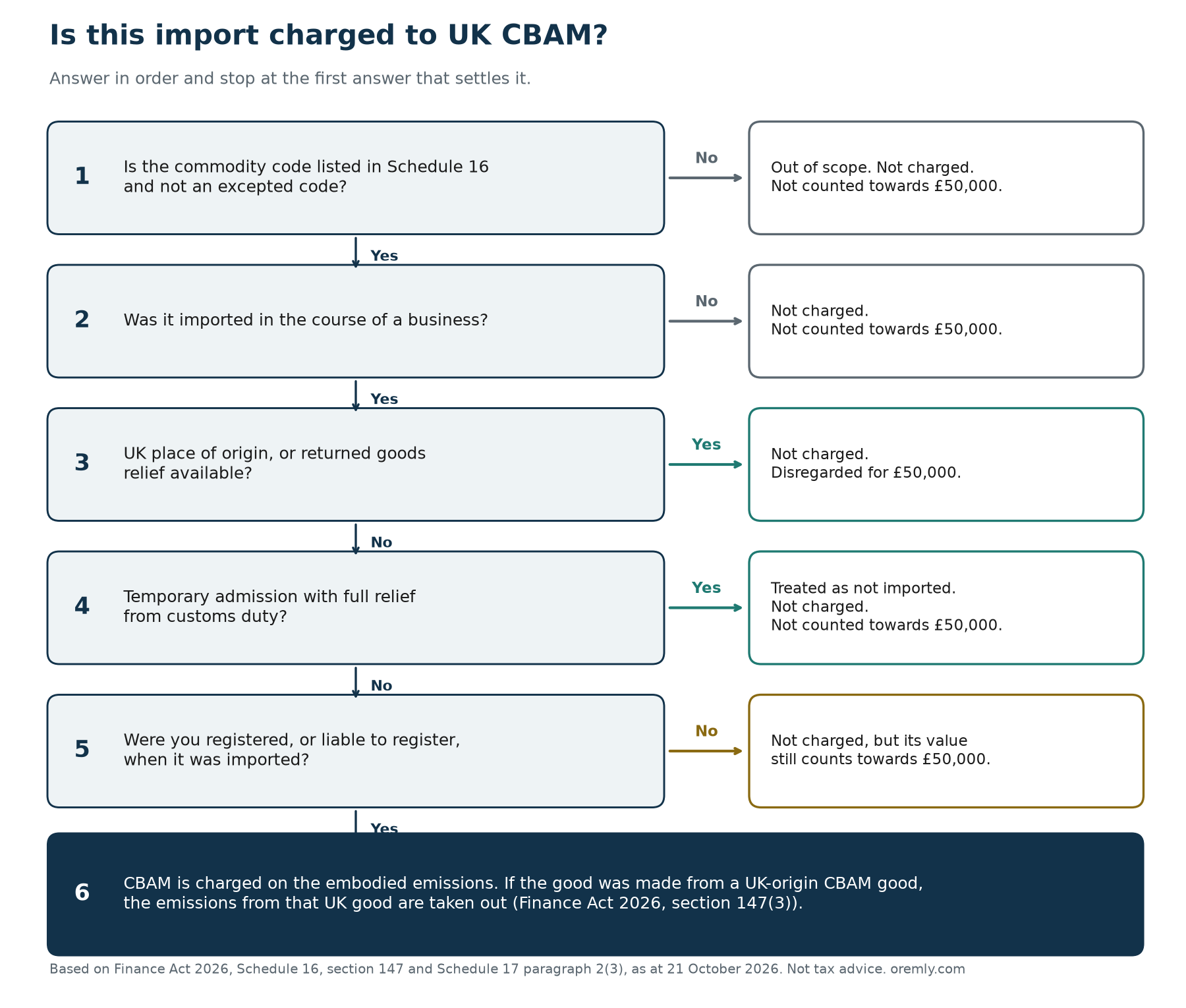
Check one import in six questions
Work through these in order for each consignment. Stop at the first answer that settles it.
1. Is the commodity code listed in Schedule 16 and not excepted? If not, the goods are out of scope. Not charged, and not counted towards £50,000.
2. Was it imported in the course of a business? If not, it is not charged and not counted.
3. Does it have a UK place of origin, or is returned goods relief available? If so, it is not charged and is disregarded for the £50,000 threshold. Keep the origin or relief evidence.
4. Did it enter temporary admission with full relief from duty? If so, it is treated as not imported, not charged and not counted towards £50,000, unless that relief stops applying.
5. Were you registered, or liable to register, at the time it was imported? If not, it is not charged, but its value does count towards £50,000.
6. If you were, CBAM is charged on the embodied emissions. If it was made from a UK-origin CBAM good, the emissions from that UK good are taken out.
Worked example: which consignments are charged
Illustrative only. The business, goods, dates, weights and values below are made up. The default value is from the government's draft notice of 16 October 2026 and the £9.69 rate is HMRC's illustrative iron and steel rate of 16 October 2026, not the rate that will apply.
A builders' merchant starts importing in January 2027. It is not registered. It never expects £50,000 or more of in-scope imports within any 30-day period, so the forward-looking test is not met. Its 2027 imports, up to April:
| Date (2027) | Goods (heading) | Value | Counts towards £50,000? | Running total |
|---|---|---|---|---|
| Monday 18 January | Hex bolts (7318) | £16,000 | Yes | £16,000 |
| Monday 22 February | I sections (7216) | £19,000 | Yes | £35,000 |
| Monday 15 March | Nails (7317) | £9,000 | No, not a CBAM good | £35,000 |
| Friday 26 March | UK-made steel brackets returned by an overseas customer, returned goods relief available (7326) | £7,000 | No, disregarded | £35,000 |
| Friday 9 April | 30 tonnes of hot-rolled coil under 3 mm, not pickled (72083900) | £21,000 | Yes | £56,000 |
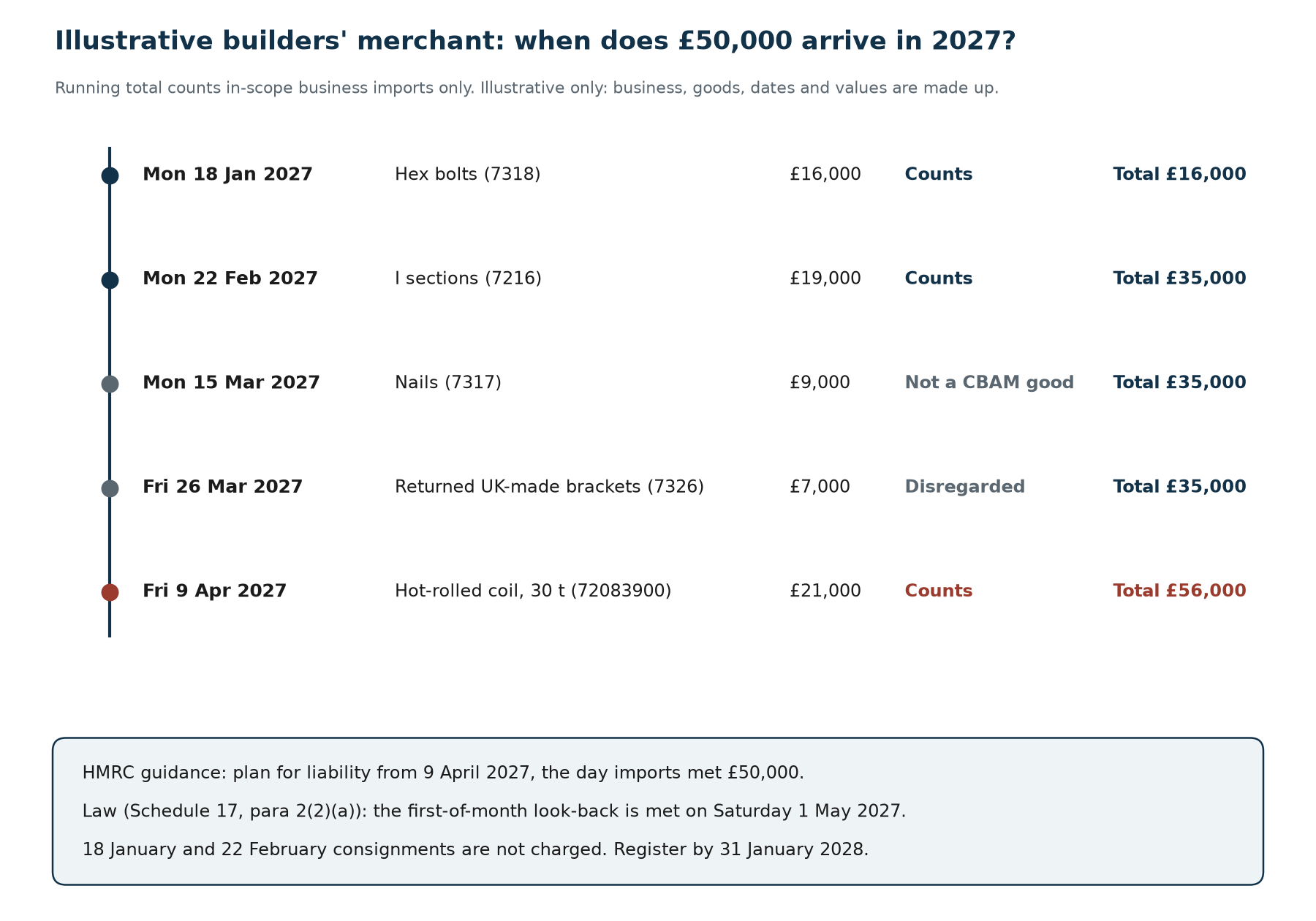
When does the merchant become liable? The two sources say different things, so plan from both:
- HMRC's guidance says that when the monthly look-back finds £50,000 or more, "you may be liable to register for CBAM from the date your imports met the £50,000 registration threshold". In-scope imports reached £56,000 on 9 April 2027, so plan for liability from that day.
- The law (Schedule 17, paragraph 2(2)(a)) applies the 12-month look-back when "it is the first day of the month". The first check after 9 April is Saturday 1 May 2027.
Which consignments are charged? Section 147(1)(a) says CBAM is not charged if, when the goods are imported, the importer is neither registered nor registrable.
- 18 January and 22 February: imported before 9 April, so not charged on either reading. Their £35,000 still counted towards the threshold.
- 15 March (nails) and 26 March (returned brackets): not charged in any case, and not counted.
- 9 April (coil): HMRC's guidance dates liability from the day imports met £50,000, which is the day of this import. It does not say whether this consignment is itself charged, so plan for it to be charged. On the law's first-of-month wording, the merchant was not registrable until 1 May, so it would not be charged. HMRC's policy summary also says liability under the look-back "begins on the day they applied the test". We plan on the HMRC basis because it is the cautious one.
What the 9 April consignment could cost on the planning basis: 30 tonnes × 3.468 tCO2e per tonne (draft default value for 72083900) = 104.04 tCO2e. At HMRC's illustrative £9.69: 104.04 × £9.69 = £1,008.15, so about £1,008, before any carbon price relief. The real figure would use the published iron and steel rate for 1 April to 30 June 2027.
What if the merchant had counted everything? Adding the nails and the returned brackets, the running total would have reached £51,000 on 26 March, two weeks early. Counting out-of-scope and disregarded goods does not change what is charged, but it can bring forward the date you plan to register from.
Registration deadline. Because the merchant triggers registration in 2027, the transitory rules give it until 31 January 2028 to register. GOV.UK says registration opens on 1 January 2028. Every in-scope consignment from the liability date onwards, including 9 April on the planning basis, goes on the 2027 return, due with payment by 31 May 2028.
EU goods are not exempt today
Section 156 of the Finance Act 2026 lets the Treasury, by regulations, exclude goods from a country with an emissions trading scheme linked to the UK's, both from the charge and from the threshold. No such regulations have been made, and HMRC's policy summary says: "There are currently no jurisdictions exempt from CBAM."
The draft default values notice of 16 October 2026 refers to "the commitment expressed by the UK and EU to link their emissions trading schemes which will result in EU-origin goods being exempt from UK CBAM". That is a stated intention, not an exemption in force. Until regulations are made, budget for EU-origin CBAM goods like any others. For how the two schemes differ today, see UK CBAM vs EU CBAM.
Keep evidence for every exemption you rely on
HMRC's record-keeping guidance lists "evidence for any exemptions from CBAM" among the records every importer of CBAM goods must keep from 1 January 2027. In practice that means:
- UK origin: the origin evidence for the goods.
- Returned goods: the export records and the returned goods relief claim on the import declaration.
- Temporary admission: the declaration and evidence that full relief applied, and the date it ended if it did.
- Out of scope: a note of the commodity code and why it is not in Schedule 16. Not strictly an exemption record, but it answers the obvious question at an HMRC check.
Records must be kept for 6 years from the later of the date they were created and the end of the accounting period they relate to. See our CBAM records guide.
A checklist for finance and ops teams
1. Pull every 2027 purchase line with an iron, steel or aluminium commodity code, and mark each as in scope or out of scope against Schedule 16.
2. Flag any goods of UK origin, any returns of goods you exported, and any temporary admission entries.
3. Build your £50,000 running total from in-scope business imports only, leaving out UK-origin goods, returned goods and temporary admission goods with full relief.
4. Check the 30-day forward test too: if you expect £50,000 or more of in-scope imports in the next 30 days, you are liable from that day.
5. Note the date your total reaches £50,000. HMRC's guidance dates liability from that day; the law applies the look-back on the first day of the next month. Plan from the earlier date. If the forward test is met too, HMRC says to "use the earliest date on which you become liable for CBAM as your registration start date". Use the CBAM threshold checker to track your running total.
6. Keep the evidence for every exemption for 6 years.
7. Watch for HMRC's detailed exemptions guidance, due before 1 January 2027, and any announcement after the UK-EU summit.
Common mistakes
- Assuming small consignments are exempt. There is no de minimis in UK CBAM.
- Leaving early imports out of the threshold count. Imports made before you are liable are not charged, but they still count towards £50,000.
- Counting UK-origin or returned goods towards the threshold. The law tells you to disregard them.
- Treating nails, chain or mesh as CBAM goods, or treating bolts as out of scope. Check the heading.
- Budgeting as if EU goods are exempt. No exemption is in force.
- Relying on temporary admission with only partial relief. CBAM applies.
Reader questions
Do imports before I become liable ever get charged?
No. Section 147(1)(a) says CBAM is not charged if you were neither registered nor registrable when the goods were imported. The open question is the exact day you become registrable. HMRC's guidance dates it from the day your imports reached £50,000; the law applies the look-back on the first day of the next month. Plan from the earlier date.
Is aluminium scrap exempt?
It is out of scope, because heading 7602 is not listed in Schedule 16. Ferrous scrap (7204) is listed as an exception within chapter 72.
Are goods from Northern Ireland exempt?
Union goods that left Northern Ireland and come back within 3 years in the same state are covered by the returned goods exemption. Other Northern Ireland and Isle of Man cases have their own import rules in section 144, so take advice if this applies to you.
I import under inward processing. Is that an exemption?
No. HMRC's policy summary says the charge arises when the goods pass the tax point, and if a CBAM good is processed into a non-CBAM good, CBAM is charged on the CBAM good's share. If the processed goods are exported before the tax point, there is no CBAM.
Where Oremly fits
Oremly helps UK importers map each product to its commodity code, mark goods as in scope, out of scope or exempt, keep a running £50,000 total that leaves out disregarded goods, and store the evidence for each exemption. You still register and file with HMRC.
Sources
Primary sources checked on 21 October 2026:
- Finance Act 2026, Part 5 (section 143 charge, section 144 importation, section 147 exemptions, section 156 linked emissions trading schemes)
- Finance Act 2026, Schedule 16 (CBAM goods)
- Finance Act 2026, Schedule 17 (paragraph 2, registration and the £50,000 threshold)
- The CBAM (Transitory Provision) Regulations 2026, S.I. 2026/830 (31 January 2028 registration deadline for 2027 triggers; 31 May 2028 return)
- CBAM: policy summary (HMRC, updated 16 October 2026)
- Work out the date you'll need to register for CBAM (HMRC guidance)
- Keeping records for CBAM (HMRC guidance, updated 16 October 2026)
- The CBAM (Default Values) Force of Law Notice (Draft) (16 October 2026)
- Illustrative CBAM rates and worked example (HMRC, 16 October 2026)
- UK Trade Tariff (heading descriptions for 7312 to 7325, 7602 and 7615)
Free founding access until 1 January 2027. No card required. From 1 January 2027, Oremly is £149/month, and founding members keep that price until 1 January 2029. We'll notify you before billing starts.
Ready to simplify your CBAM compliance?
Free until 1 January 2027 · £149/month locked until 2029 · No card required
Start free founding access