How to contact HMRC about UK CBAM: which route to use, and a question template
Last verified: 26 October 2026
Author: Oremly
Short answer: Since 20 October 2026, HMRC has had a GOV.UK page called Send HMRC questions about CBAM. General questions go through an online form, which needs a sign-in. Detailed policy and technical questions, and requests to join the CBAM mailing list, go by email to cbampolicyteam@hmrc.gov.uk. HMRC says it will "usually send you a reply by email within 15 days". The page gives no phone number.
This post sets out which route fits which question, what to put in the message so you get a useful answer, how to plan around the reply time before CBAM starts on 1 January 2027, and a template you can copy. It is not tax advice. Oremly is software and plain-English guidance.
Which route to use
| Your question | Route | What HMRC says about the reply |
|---|---|---|
| Whether CBAM applies to you, help with registration, reporting and record keeping (HMRC calls these "general queries") | HMRC online form. You need a Government Gateway user ID or GOV.UK One Login, or you can create sign-in details | Usually by email within 15 days |
| Your circumstances are not covered by the published guidance, you need to know about a policy area not yet finalised, or the published method does not fit your product or production process | Email cbampolicyteam@hmrc.gov.uk | Usually by email within 15 days |
| You think there is a gap or problem in the guidance | Email cbampolicyteam@hmrc.gov.uk | Usually by email within 15 days |
| You want to join the CBAM mailing list | Email cbampolicyteam@hmrc.gov.uk with "CBAM mailing list" in the subject | Not stated |
| Feedback on HMRC's CBAM technical guidance for monitoring, verifying and reporting emissions | Email cbampolicyteam@hmrc.gov.uk with "MRV technical guidance feedback" in the subject, on or before 13 November 2026 | HMRC will consider all feedback and may update the guidance before 1 January 2027 |
| Which commodity code your goods fall under | Not the CBAM team. Email the Tariff Classification Service at classification.enquiries@hmrc.gov.uk for non-binding advice, or apply for an Advance Tariff Ruling for a legally binding decision (for goods moving into or out of Northern Ireland, HMRC says to apply for a Binding Tariff Information decision instead) | Classification email: HMRC aims to reply within 5 working days. Advance Tariff Ruling: 30 to 120 days, and you must apply before customs procedures for the goods are completed |
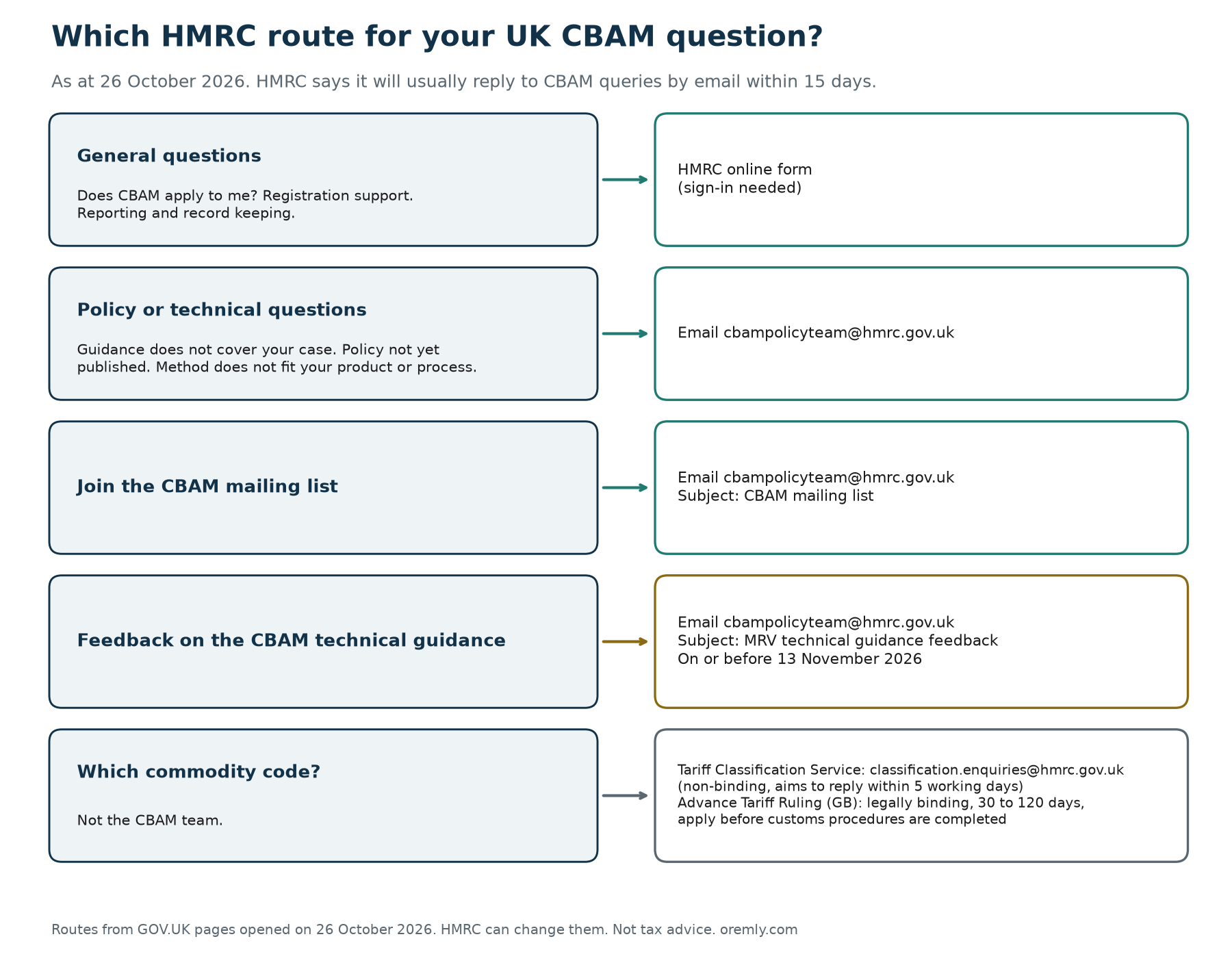
Three points on the routes:
1. Commodity codes come first. CBAM scope is decided by the commodity code. Schedule 16 of the Finance Act 2026 lists CBAM goods mainly by chapter, 4-digit heading and 6-digit sub-heading, with a few 8-digit codes. If your real question is "which code is this?", the classification routes above are built for it, and you can check scope against the list in Finance Act 2026, Schedule 16. Of the two, only an Advance Tariff Ruling is legally binding.
2. There is an older address in circulation. HMRC's CBAM policy summary (last updated 16 October 2026) still says to email cbamenquiries@hmrc.gov.uk for "operational CBAM enquiries". The newer query page (20 October 2026) does not mention that address and sends general queries to the online form instead. We would use the routes on the newer page.
3. "15 days" is not defined. The page does not say whether it means calendar days or working days. The worked example below plans on working days, which is the cautious reading.
Before you ask: check the answer is not already published
HMRC's query page is for when "you cannot find information" in what it has published, and a question that quotes the guidance is easier to answer than one that does not. The pages most CBAM questions turn on, all on GOV.UK:
- CBAM policy summary (scope, exemptions, registration, returns)
- Check if you'll need to register and work out the date you'll need to register
- Keeping records for CBAM
- Verifying emissions data and the CBAM technical guidance
- The draft default values (on the force of law notices page) and the illustrative rates, both linked from the Prepare for CBAM collection
On Oremly, does UK CBAM apply to my business?, when to register and UK CBAM exemptions answer the questions we see most often, with the HMRC source for each point. The CBAM threshold checker shows when your running total reaches £50,000.
What to put in your question
The policy team can only answer the question it can understand. Include:
1. Who you are. Company name, a contact name, email address and phone number.
2. The goods. The commodity code from your import declaration (8 digits if you have it), a plain description, and roughly how much you import (value and tonnes per month or year).
3. The question, in one sentence. If you have two questions, send two messages. The Tariff Classification Service asks for one email per item; it is a sensible habit for CBAM too.
4. What you have already read. Name the GOV.UK page or the paragraph of the Act, with the date it was last updated, and quote the words that leave you unsure.
5. Why it is unclear for you. For example, two sources that seem to say different things, or a production route that is not in the technical guidance.
6. What you plan to do in the meantime. This shows HMRC the practical effect of its answer.
Leave out anything you would not want in an email chain, such as supplier price lists. If HMRC needs more, it will ask.
A template you can copy
> To: cbampolicyteam@hmrc.gov.uk
> Subject: UK CBAM policy question: [topic in a few words]
>
> We are [company name], a UK importer of [goods]. Contact: [name], [email], [phone].
>
> Goods: commodity code [8-digit code], [description], about [tonnes] tonnes and £[value] a year, from [number] overseas installations.
>
> Question: [one sentence].
>
> What we have read: [GOV.UK page or legislation reference, last updated date]. It says: "[short quote]".
>
> Why we are unsure: [one or two sentences].
>
> What we will do until we hear from you: [your planning assumption].
>
> Please confirm [the specific point]. Thank you.
Two sample questions
A technical question (illustrative). A fastener importer's supplier already has emissions data verified for EU CBAM. HMRC's verification guidance says that to use actual emissions, the installation's data must be verified, and the verifier must be accredited for CBAM by an eligible accreditation body against ISO/IEC 17029 and ISO 14065. HMRC's policy summary says the methods are "broadly designed to support interoperability with the EU CBAM". We have not found an HMRC statement on whether an EU CBAM verification can be used as it stands. That is a fair question for the policy team: "Can verified emissions data and a verification report prepared for EU CBAM be used on a UK CBAM return, or does the installation need a separate verification by a verifier accredited for UK CBAM?" Until HMRC answers, plan on the draft default values. Our post on default values or supplier data shows how to compare the two.
A policy question about the liability date. The law and HMRC's guidance describe the backward-looking threshold test differently. Schedule 17, paragraph 2(2)(a) of the Finance Act 2026 applies the 12-month look-back when "it is the first day of the month". HMRC's registration date guidance says that if the monthly check finds £50,000 or more, "you may be liable to register for CBAM from the date your imports met the £50,000 registration threshold". If your imports cross £50,000 mid-month, those can be different dates. Plan from the earlier one, the day your imports reached £50,000, and if you want certainty, ask the policy team which date HMRC will apply. The CBAM threshold checker shows when your running total crosses £50,000.
Worked example: timing your question before 1 January 2027
Illustrative only. The business and its send date are made up. The dates for the reply window are worked out from HMRC's "within 15 days" and the England and Wales bank holidays on GOV.UK.
A fastener importer sends its verification question to cbampolicyteam@hmrc.gov.uk on Monday 2 November 2026.
- If "15 days" means calendar days: 2 November + 15 days = Tuesday 17 November 2026.
- If it means working days: counting 15 working days from Tuesday 3 November (there are no bank holidays in November 2026) takes you to Monday 23 November 2026.
Plan on 23 November. If there is no reply by then, send a short chaser quoting the date of the first email.
The same importer also has comments on the technical guidance. Those go in a separate email with "MRV technical guidance feedback" in the subject, by Friday 13 November 2026, which is before either reply date. Do not wait for the answer to the first question before sending feedback.
Latest date to ask and still expect a reply before CBAM starts. To have an answer by Thursday 31 December 2026:
- On calendar days: 31 December minus 15 days = Wednesday 16 December 2026.
- On working days: Christmas Day (Friday 25 December) and the substitute Boxing Day holiday (Monday 28 December) are not working days. Counting back 15 working days from 31 December gives a latest send date of Tuesday 8 December 2026.
So send any question you need answered before 1 January 2027 by 8 December 2026. These are planning dates, not HMRC deadlines. Nothing in the rules makes you wait for an answer before importing, and the first return for 2027 imports is not due until 31 May 2028. The reason to ask early is that supplier contracts and data requests for 2027 are being agreed now.
After HMRC replies
- Keep the reply with your CBAM records, together with the email you sent. HMRC's record-keeping guidance asks for records to be kept for 6 years. A dated question and answer is useful if your treatment is ever queried. Our CBAM records guide lists what else to keep.
- Do not treat it as a ruling unless HMRC says it is one. The CBAM query page does not say whether you can rely on a reply, and it is not described as a clearance service. HMRC's general Non-Statutory Clearance Service has its own rules. Its guidance does not mention CBAM, so whether it covers CBAM questions is not confirmed.
- Re-check when guidance changes. HMRC says the technical guidance may be updated before 1 January 2027, and the first real CBAM rates for January to March 2027 are due before the end of 2026.
Emails from HMRC about CBAM
HMRC may also contact you. Its page check if an email you've received from HMRC is genuine says HMRC may email importers who could be affected by CBAM, explaining what CBAM is, which goods it applies to and who is likely to be affected. If an email about CBAM asks for payment or bank details, check it against that page before you act.
Common mistakes
- Asking the CBAM team which commodity code to use. Use the Tariff Classification Service or an Advance Tariff Ruling.
- Sending several questions in one email. One question per message is easier to answer and to file.
- Asking without quoting the guidance. If the answer is already on GOV.UK, you will be pointed back to it, and you have lost two weeks.
- Looking for a phone line. The CBAM query page lists an online form and an email address, not a phone number.
- Waiting for a reply before preparing. Use the draft default values and the cautious liability date in the meantime.
Reader questions
Is there a UK CBAM phone number?
HMRC's CBAM query page and the CBAM policy summary give no phone number, as at 26 October 2026. The routes are the online form and cbampolicyteam@hmrc.gov.uk.
How do I join the HMRC CBAM mailing list?
Email cbampolicyteam@hmrc.gov.uk and put "CBAM mailing list" in the subject.
Does HMRC run CBAM webinars?
Yes. HMRC's Agent Update issue 147 (September 2026) said HMRC was "hosting a series of webinars in October 2026 to help impacted businesses and their agents implement CBAM". We have not found a public booking page for them. A recorded CBAM video is on HMRC's email updates, videos and webinars about importing and exporting page, added on 6 August 2026. To hear about future sessions, ask to join the CBAM mailing list.
Can my customs broker or tax agent ask on my behalf?
The query page does not say. HMRC's policy summary says the importer is the liable person, and a tax agent can act for you and submit CBAM returns but cannot register for CBAM on your behalf. Whoever sends the question, make sure it describes your goods and that you see the reply.
Where Oremly fits
Oremly helps UK importers map each product to its commodity code and keep a running £50,000 total, so any question you send HMRC already has the codes, values and dates in it. You still register, file and ask HMRC directly.
Sources
Primary sources checked on 26 October 2026:
- Send HMRC questions about CBAM (HMRC, first published 20 October 2026, updated 21 October 2026)
- CBAM: policy summary (HMRC, updated 16 October 2026)
- Prepare for CBAM and Check if you'll need to register (HMRC collections)
- Work out the date you'll need to register for CBAM (HMRC, 16 July 2026)
- Finance Act 2026, Schedule 17, paragraph 2
- Finance Act 2026, Schedule 16 (CBAM goods by commodity code)
- CBAM technical guidance for monitoring, verifying and reporting emissions (HMRC, 16 October 2026)
- Verifying emissions data for CBAM goods (HMRC, 16 October 2026)
- Keeping records for CBAM (HMRC, updated 16 October 2026)
- Ask HMRC for help classifying your goods and Apply for an Advance Tariff Ruling (HMRC)
- Find out about the Non-Statutory Clearance Service (HMRC, updated 26 August 2026)
- Check if an email you've received from HMRC is genuine (HMRC, CBAM entry added 12 October 2026)
- HMRC email updates, videos and webinars about importing and exporting (HMRC, CBAM video added 6 August 2026)
- Agent Update: issue 147 (HMRC, September 2026)
- UK bank holidays (GOV.UK, England and Wales)
Free founding access until 1 January 2027. No card required. From 1 January 2027, Oremly is £149/month, and founding members keep that price until 1 January 2029. We'll notify you before billing starts.
Ready to simplify your CBAM compliance?
Free until 1 January 2027 · £149/month locked until 2029 · No card required
Start free founding access