UK CBAM default values or supplier data: a decision test for 2027 imports
Last verified: 26 October 2026
Author: Oremly
For every CBAM good you import, you report its emissions using one of two figures: a verified actual figure from the producer, or a default value set by the government. You must use the default if you do not hold evidence that the producer's figure has been verified. And once a return has been filed using a default value, you cannot amend it to swap in actual data later.
So the real question for 2027 is not "which is cheaper?" but "will I have verified supplier data in hand by the time I file?" This post gives you a five-question test to answer that for each supplier, an illustrative example with every date worked out, and the questions to send your suppliers now.
It is not tax advice. Oremly is software and plain-English guidance; you file your own returns with HMRC. If you have not yet checked whether UK CBAM applies to you, start with does UK CBAM apply to my business? and the CBAM threshold checker.
Where UK CBAM default values stand today
On 16 October 2026 the government published the UK default values in a draft notice, the CBAM (Default Values) Force of Law Notice (Draft). The main points:
- 570 default values, one for each listed 8-digit CN code, in tCO2e per tonne of product.
- A 10% markup in every sector except fertiliser, where no markup is applied.
- They apply from 1 January 2027 to 31 December 2028. From 2029 the UK plans to move to country-specific values, with one default value per CBAM good per country.
- They are not law yet. The notice is a draft and has no force of law until it is commenced on 1 January 2027, so the figures could change before then.
- They are based on EU data but are not the EU figures. The notice says the UK values are set on a trade-weighted average of UK imports, and that "Data from the EU is excluded".
Some examples from the draft notice, all tCO2e per tonne:
| Goods (CN code) | Draft default value |
|---|---|
| Hot-rolled coil, under 3 mm, not pickled (72083900) | 3.468 |
| I sections, height 80 to 220 mm (72163211) | 2.633 |
| Hex bolts, non-stainless, under 800 MPa (73181582) | 4.796 |
| Hex bolts, non-stainless, 800 MPa or more (73181588) | 6.077 |
The law behind them (Finance Act 2026, Schedule 17, paragraph 11) says three things:
- They are set by the Treasury by notice, not by HMRC guidance or by the EU.
- They can vary depending on where the emissions were emitted. The draft values for 2027 and 2028 are one per good; country-specific values are planned from 2029.
- They may be set at a level that gives no advantage to an importer who uses them instead of verified data. The law says "advantage" includes lower emissions and also not bearing the cost of getting emissions verified. The draft notice applies that principle through the 10% markup, so a verified figure from a producer close to the average for its product would usually be lower than the default.
Do not budget with EU CBAM default values. They are a separate set of figures under EU law. Use only the UK draft default values notice.
What counts as actual supplier data
"Actual data" means the emissions intensity of the good (tonnes of CO2 equivalent, tCO2e, per tonne) worked out by the installation that produced it and verified as satisfactory by a qualifying verifier. An email with a number in it is not enough.
According to HMRC's verification guidance (published 16 October 2026) and the policy summary, the verifier must:
- be independent of the installation;
- be accredited for CBAM by an eligible accreditation body, against ISO/IEC 17029:2019 and ISO 14065:2020. HMRC's technical guide says accreditation bodies in any country, not just the UK or Europe, can be eligible;
- be accredited for the right activity: the scope of the accreditation must cover the installation's production processes. A verifier accredited for fertiliser production, for example, is not automatically eligible to verify an iron and steel installation.
The verifier produces a verification report. The producer can send you a good-specific verification summary instead of the full report. Whichever you get, you must keep it for six years, because it is your evidence for the figure on your return. The detail of what verifiers must do is in HMRC's CBAM technical guidance, also published on 16 October 2026. HMRC is taking technical feedback on it until 13 November 2026 and may update it before 1 January 2027.
When the choice locks in
The decision point is the date you file the return, not the date the goods arrive.
- The first UK CBAM accounting period is the whole of 2027: 1 January to 31 December 2027.
- The return and payment for it are due by 31 May 2028.
- If you file that return using a default value for a good, Schedule 17 (paragraph 8(2)) stops you amending it later to replace the default with actual data. You can still amend a return to correct a genuine error.
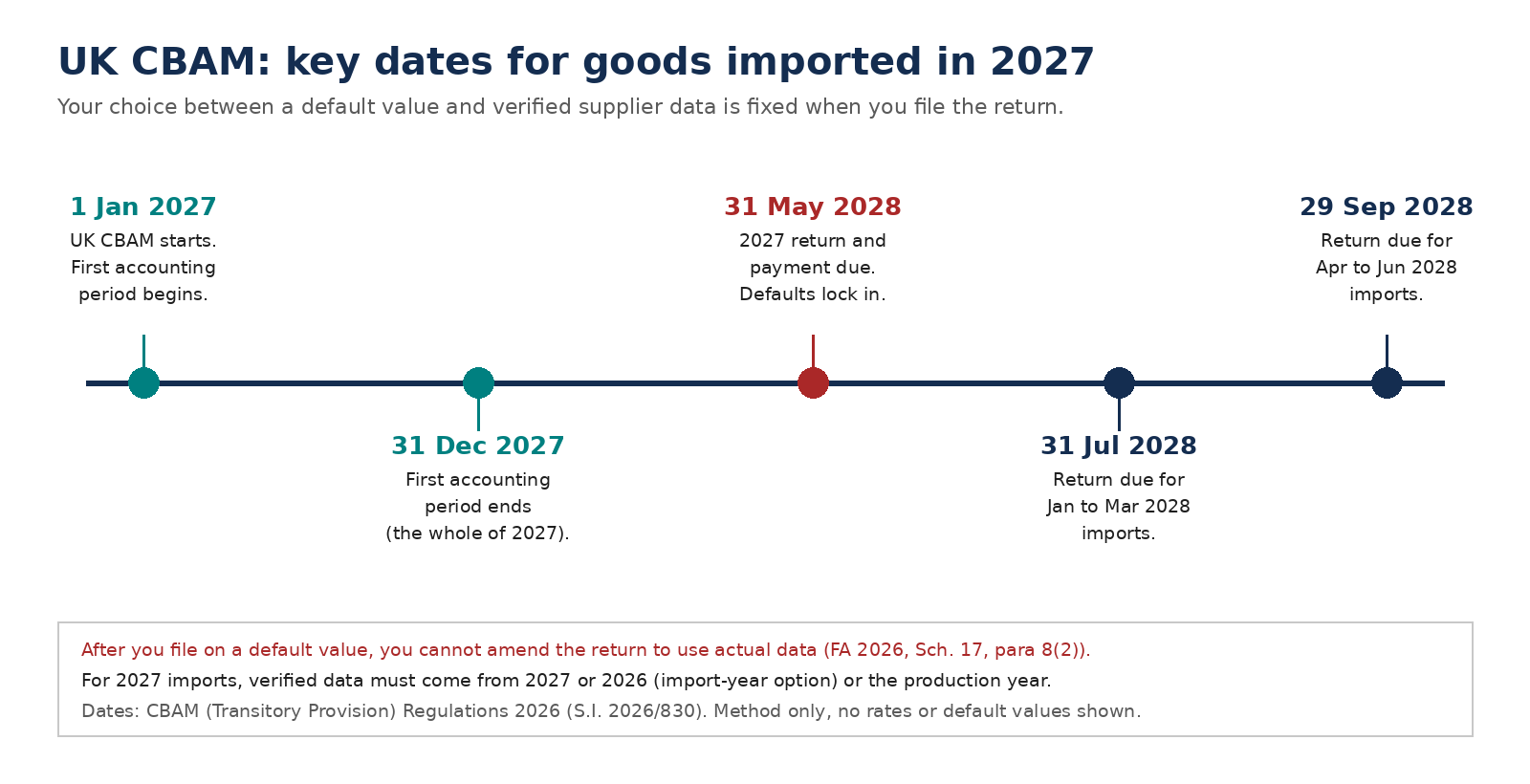
After 2027 the window gets shorter. From 1 January 2028, accounting periods are quarterly. The return for January to March 2028 is due by 31 July 2028, and the return for April to June 2028 by 29 September 2028. HMRC's policy summary shows the window then settling at about two months (for July to September 2028, the return is due by 30 November 2028). That leaves much less time to chase a late verification summary, so it is worth sorting the process out with suppliers during 2027.
Which year's data you can use
The figure must come from a calendar-year monitoring period. For goods imported before 1 January 2028, the Emissions and Verification Regulations (regulation 9) allow either:
- Option 1 (import year): the most recent year with verified data, out of the year of import and the year before. For goods imported in 2027, that means 2027 data if it has been verified, otherwise 2026 data.
- Option 2 (production year): verified data for the calendar year the good was produced.
For goods imported from 1 January 2028, Option 1 changes to the most recent verified year out of the two calendar years before the year of import. Goods imported in 2028 would use 2027 data, or 2026 data if 2027 has not been verified.
The practical point: for most 2027 imports, the figure you can actually get in time is the producer's 2026 figure. If your supplier is not monitoring and verifying its 2026 emissions on the UK basis, you may end up on default values for 2027.
The five-question decision test
Run this for each supplier and each good you buy from them. If the answer to any question is no, plan to use the default value for that good, and budget for it.
1. Will the producer give you an emissions intensity for this specific good? You need a figure for the good you actually import, from the installation that made it, not a company-wide average.
2. Will it be verified as satisfactory by a verifier accredited for that activity? Ask who the verifier is and what they are accredited for.
3. Will you hold the verification report or good-specific summary before you file? For 2027 imports, set your own cut-off comfortably before 31 May 2028.
4. Is it for an allowed monitoring period? For 2027 imports, that is 2027 or 2026 under Option 1, or the production year under Option 2.
5. If the good is made from other CBAM goods, does the figure include their emissions? Complex goods carry the emissions of their precursor goods. The producer can use default values for the precursors even when the final good has a verified actual figure.
If all five answers are yes, using the verified figure is open to you. Whether it is worth the effort depends on how far your supplier's figure is below the draft default for that CN code, and on what the data costs you to get. You can now check the gap code by code.
Illustrative example: one stockholder, two mills
Illustrative only. The businesses, tonnages, dates and gaps below are made up to show the method. The default value is from the draft notice of 16 October 2026. The £9.69 rate is HMRC's illustrative iron and steel rate of 16 October 2026: it is not a forecast and not the rate that will apply.
A UK steel stockholder buys from two overseas mills in 2027:
| Supplier | Consignment | Arrival (tax point) | Net weight |
|---|---|---|---|
| Mill A | Hot-rolled coil | 8 February 2027 | 400 tonnes |
| Mill A | Hot-rolled coil | 21 September 2027 | 350 tonnes |
| Mill B | I sections, height 80 to 220 mm (CN 72163211) | 5 July 2027 | 300 tonnes |
Mill A passes all five questions. Its verifier is accredited for iron and steel, and it sends a good-specific verification summary for its 2026 production. When the stockholder files in May 2028, the verification of Mill A's 2027 data has not yet been completed.
- Both Mill A consignments arrived in 2027, so under Option 1 the allowed years are 2027 and 2026.
- 2027 has no verified data yet at filing, so the most recent verified year is 2026. Both consignments use Mill A's 2026 figure.
- The stockholder must keep the summary for six years beginning with the day after the 2027 accounting period, so until 31 December 2033 (S.I. 2026/995, regulation 16(3)). HMRC's record-keeping guidance counts six years from the later of the date a record was created and the end of the accounting period, so if the summary is created after 31 December 2027, keeping it for six years from that date covers both.
Mill B says it will "try to send something next year" but cannot name a verifier.
- The stockholder sets an internal cut-off of Friday 28 April 2028, about a month before the deadline (30 April 2028 is a Sunday).
- Nothing verified has arrived by then, so the Mill B consignment goes on the return using the default value.
- Even if Mill B sends a verified summary in July 2028, the stockholder cannot amend the return to use it for this consignment.
What the default could cost. The draft default value for Mill B's I sections (CN 72163211) is 2.633 tCO2e per tonne. At HMRC's illustrative £9.69:
- Per tonne: 2.633 × £9.69 = £25.51 per tonne of sections, before any carbon price relief.
- For 300 tonnes: 300 × 2.633 = 789.9 tCO2e; 789.9 × £9.69 = £7,654.13.
The useful question is the gap between that default and a verified figure. Every 0.10 tCO2e per tonne of gap is worth about £0.97 per tonne at the illustrative rate. For Mill B's 300 tonnes:
| Gap between the default and a verified figure | Extra embodied emissions | Extra cost at HMRC's illustrative £9.69 per tCO2e |
|---|---|---|
| 0.10 tCO2e per tonne | 300 × 0.10 = 30 tCO2e | 30 × £9.69 = £290.70 |
| 0.50 tCO2e per tonne | 300 × 0.50 = 150 tCO2e | 150 × £9.69 = £1,453.50 |
At today's illustrative rate the sums are modest, so weigh them against what verified data costs you. The gap is worth more on goods with higher defaults, such as bolts, and it grows if the rate rises as UK free allowances are phased out.
The rate actually used would be the published iron and steel rate for the quarter of the tax point (July to September 2027 for Mill B), less any carbon price relief. For the full calculation, see how is UK CBAM calculated?
Questions to send your suppliers now
You can copy these into an email to each producer. Ask for answers in writing.
- [ ] Which installation produces the goods you sell us, and for which commodity codes? (Check the codes against Finance Act 2026, Schedule 16.)
- [ ] Are you monitoring your 2026 and 2027 emissions for these goods on the UK CBAM basis?
- [ ] Which verifier will verify the data, which accreditation body accredited them, and for which activities?
- [ ] When do you expect the verification for 2026, and for 2027, to be complete?
- [ ] Will you send us a good-specific verification summary for each good we buy?
- [ ] If the goods are made from other CBAM goods, does your figure include those precursor emissions?
- [ ] Do you pay a carbon price at the installation, and can you provide a carbon pricing verification form? (This is for carbon price relief, a separate claim.)
- [ ] Can you commit to sending documents for 2027 deliveries by a date we agree, such as 28 April 2028?
HMRC published its verification guidance and a technical guide on 16 October 2026. We have not found anything in them saying that a verification done for EU CBAM will be accepted as it stands for UK CBAM. They say the verifier must be accredited for CBAM by an eligible accreditation body, with a scope that covers the installation. If a supplier tells you its EU verification "covers the UK", ask them to show you where HMRC says so. You can also put the question to HMRC yourself: its CBAM query page takes detailed policy and technical questions at cbampolicyteam@hmrc.gov.uk, and HMRC says it will "usually send you a reply by email within 15 days".
Common mistakes to avoid
- Filing on defaults "for now" and planning to amend later. The law does not allow you to replace a default with actual data by amendment.
- Accepting an unverified figure. Without a verification report or summary, you must use the default.
- Budgeting with EU default values. The UK has its own draft figures, published on 16 October 2026. Use those.
- Using the wrong year. For 2027 imports, Option 1 allows only 2027 or 2026 data.
- Leaving it until 2028. The 2027 return gives you five months after the year end. From 2028, quarterly returns leave much less time.
Where Oremly fits
Oremly helps UK importers read the import ledger, chase supplier emissions data, calculate liability, store evidence and prepare a return-ready summary. It does not file the return; you file through HMRC. To check whether you are likely to cross the £50,000 threshold first, try the CBAM threshold checker, and for HMRC's full guidance see the CBAM collection on GOV.UK.
Sources
Primary sources checked on 26 October 2026:
- Finance Act 2026, Schedule 17 (paragraph 8 amendments; paragraph 11 default values)
- S.I. 2026/995, the CBAM (Emissions and Verification) Regulations 2026 (regulation 4 default values; regulation 9 monitoring periods; regulation 16(3) keeping the verification report or summary)
- S.I. 2026/830, the CBAM (Transitory Provision) Regulations 2026 (accounting periods and return dates to 30 June 2028)
- The CBAM (Default Values) Force of Law Notice (Draft) (16 October 2026)
- Illustrative CBAM rates and worked example (HMRC, 16 October 2026)
- Verifying emissions data for CBAM goods (16 October 2026)
- CBAM technical guidance for monitoring, verifying and reporting emissions (16 October 2026)
- CBAM policy summary (updated 16 October 2026)
- Keeping records for CBAM (updated 16 October 2026)
- Prepare for CBAM collection (updated 9 September 2026)
- Send HMRC questions about CBAM (published 20 October 2026, updated 21 October 2026)
Free founding access until 1 January 2027. No card required. From 1 January 2027, Oremly is £149/month, and founding members keep that price until 1 January 2029. We'll notify you before billing starts.
Ready to simplify your CBAM compliance?
Free until 1 January 2027 · £149/month locked until 2029 · No card required
Start free founding access